Kevin Martin almost never fails to surprise, and this new-installment of "The Bug" project featuring several Jamaican and UK dancehall and dub poetry artists is just another example of his prowess at creating something new and astonishing musically.
The differences between his first "Tapping the Conversation" (1997, with DJ Vadim), 2003's "Pressure," various EPs and 2005's "Killing Sound" compilation of hardcore electronic reggae, are vast here. The reason? A bigger budget, meaning Martin had more time to refine and actually be in the same room with the vocalists rather than through tape/disc-trading and internet transmissions, then pasting it all together at the end. Face-to-face collaborations tend to work best.
"London Zoo" edges more towards a dub sound without as much of the extreme hardness of earlier "Bug" releases, and vocals take more of a center stage role. Also different is how melodic and more expressive the vocals by the singer/MCs are, which makes for a very lively sound that must be heard to be appreciated. Still, to many this is going to sound very hard-edged and extreme. For the initiated, it's a new direction with a lot of dub layering and subtlety that could very well snag more mainstream reggae and dub fans.
"Murder We," already very popular in underground listening-circles as a single has vocalist Ricky Ranking very close to singing a mix of reggae and American R&B. While this isn't necessarily new in other contexts, it is here in a decidedly electronic environment. Ranking's vocal on the superb "Judgment" has an energy and a power that could quiet any remaining doubters and skeptics. But it's Warrior Queen who steals the show here with cuts like "Insane," and "Poison Dart," both of which can be marked as some of the more subversive cuts on the album for all the right reasons. When she raps, "What's wrong with the world? ...Has the world gone mad?," and when Ricky Ranking sings "...People killing themselves over [it]," they're both spot-on about the present state of things internationally.
The music production here is much warmer and inviting than on previous releases which could open things up more for this project of extreme electronics melded with the organic singing of authentic Jamaican and British dub and reggae vocal talent. Holding-up the UK side is the return of dub poet Roger Robinson whose wordplay is a real treasure to behold. His voice and delivery have a very powerful emotional side to them, existing comfortably within the musical environments Martin creates. Robinson's words and delivery are transcendent as always.
You have to admit, it's a good time for dubstep and hardcore dub and dancehall fans these days. These could be the outlines of the next big thing, the new punk, the new psychedelia. Get it before the final crash comes, it's good end-times (for Western capitalism anyway) music. Now, let's get Lee Perry on some sides before Babylon falls!
Showing posts with label Techno Animal. Show all posts
Showing posts with label Techno Animal. Show all posts
Saturday, October 11, 2008
The Bug-London Zoo (2008) album review


Saturday, June 28, 2008
One from the Vaults of a pre-9/11 world: A 2001 Interview with avante garde hip-hop group dälek
DÄLEK INTERVIEW
words: Matt Janovic
Big hip-hop groups and artists come and go, but some names stick, and are recalled as timeless. There is the word, and the thing itself. Without question, the New Jersey unit, dalek is of this calibre, and hip-hop is what they do so well. With their acclaimed first release of "Negro Necro Nekros", on Gern Bladsten in 1998 (and their new 12" on Matador with "post-everything" Techno Animal), the reminders of rap's wilder days were clear.words: Matt Janovic
And this is one of many paradoxes to this enigmatic group: a synthesis of the past, present, and future of rap, as well as life. And the future (by way of the past and present?) is what dalek and this interview are all about, oddly enough.
[Conducted via-the internet towards the end of January/early-February of 2001. All content the intellectual property of the author.]
| Q: | One would find it odd that a hip-hop group would be on a punk label like Gern Bladsten, but you guys are unique. How did the deal with them ever come-into-being? |
| dälek: | The O. recorded a lot of bands on the Gern Blandsten roster (Rye Coalition, All Natural Lemon and Lime Flavors, Trans Megetti, Chisel, The VanPelt, etc). From there I met Charles Maggio (owner and lead singer of RORSCHACH) and hit him off with a tape of what would be "Negro, Necro, Nekros". After listening to the demo and seeing us live with Computer Cougar he wanted to put out our record. |
| Q: | Any future plans with Techno Animal? |
| dälek: | Yeah, no doubt. I dropped vocals on the And/Or remix they did for 2nd Gen (available on NovaMute Records). We did a remix for Kid606 (Ruin It, Ruin Them, Ruin Yrself, Then Ruin Me) which Kevin Martin played sax on. And I'm dropping vocals on a track for Techno Animal's full length "Brotherhood of the Bomb" which will be available in May on Matador Records. N ot to mention future tours as well as Oktopus' barbecue this summer!! You should come out. |
| Q: | I think there is a real connection between your sound, and the cinematic. A good part of the "Negro Necro Nekros" album is made up of extended-jams, and a lot of the sounds and instrumentation is exotic. But even better than that is the feeling of tension building and releasing in your music. Like an impending explosion of violence--that sometimes never comes until you've forgotten it was always coming! |
| Oktopus /dälek: | A lot of what we do musically is built on extremes. Ying and Yang so to speak. Dynamics. We try and build up to a certain level and then drop down to nothing (which lends itself to the "cinematic experience"). Most of pop music these days seems to be at one dynamic, but if you listen to jazz (American classical) or European classical or even African or Indian classical you can feel the tension build between the high and low. It used to be that rock emulated these tensions, and hiphop/punk had the feel, but lately, everything seems dead. So it might be cinematic, it might not be, but we just feel the extremes. We're waiting for a cinematographer who can depict it. |
| Q: | In "Untraveled Road", the line "Its all this vision that obstructs our sight...", really stood-out for me. With the intensity of your music, it reminds one of the media-overload we are all exposed to every day. And also, the sensory-overload of the urban environment.; do you think at some point the overload is intentional? |
| dälek: | Of course. Desensitatation is the answer to calm a blind society. 20/20 vision only lets you see what they want you to see (laser vision correction makes you of them). Vision, one of the senses that DESCARTES doubted, does not bring you closer to the self or to creation. Without senses we are left unconnected to the world that we think we experience. Blind-men could never commit racism. |
| Q: | How exactly did the Matador 12" with Techno Animal come about? Were you aware of them before that, or did they approach you? |
| dälek: | Like I said, we had a split 12" in the works. Techno Animal became the other half. They got signed to Matador Records, and they asked if the split 12" could be a Matador release, and it worked itself out. |
| Q: | Who are your favorite Jazz artists? |
| dälek: | Charles Mingus, John Coltrane, Miles Davis (Fusion Era), Rashied Ali, Gateway Trio, Jan Hammer, Thelonious Monk, John McLaughlin, Ron Carter, Canonball Adderley, Ornette Coleman Quintet, Cecil Taylor, Wes Montgomery, William Hooker, Jesse Henry, Tor Snyder, John Abercrombie, Dave Holland, Dave Brubeck, Charlie Parker, Trilok Gurtu, Grant Green, Johnny Hammond, Roy Campbell, Dave Douglass, Kurt Rosenwinkel, Bruce Eisenbeil, Jim Black, Mark Hennen, Kai Eckhart, Benny Goodman, Duke Ellington (Cara), Ravish Momin, Herbie Hancock, Danny Zanker, Eric Gale, Chick Corea, Revolutionary Ensemble (Jerome Cooper, Sirone, Leroy Jenkins), Charles Hayden, Alice Coltrane, Pharoah Sanders, Freddie Hubbard, Stanley Turrentine, Don Cherry, Ramsey Lewis, Hubert Laws, Tony Williams, Billy Cobham, Jack DeJohnette, Paul Desmond, Philly Joe Jones, Dizzy Gilespie, Anthony Davis, and those who we may have forgotten and are yet to discover. |
| Q: | So exactly who makes up Dalek, and what do they do? |
| dälek: | Still (DJ, Co-Producer); Oktopus (Co-Producer/Engineer); dälek (MC/Co-Producer) and Deadverse which includes said members and: Joshua Booth (Co-Producer) and Balthazar (Co-Producer). |
| Q: | There seems to have been some confusion that the Gern Bladsten album, "Negro Necro Nekros" was an EP. You guys want to clear that one up for the folks? |
| dälek: | I look at it like a jazz album. Its five songs, but its close to 40 minutes of music. |
| Q: | The Raga samples are great, it wasn't obvious at all. I've heard a few hip-hop acts use Indian music alright, but it always came-off as too "hippie." But you guys use a pretty nice palette of sounds--just about anything. What makes you decide on using one sound over another? |
| dälek: | We don't really choose one sound over another, its what works best with the song. We don't tend to think about it that hard, it needs to be natural. Scott LaRock. |
| Q: | What is your basic instrument/turntable setup (no need for exact specifics if you don't want to) live or the studio? |
| dälek: | Laptop, Turntables, mad Efx, and Vocals. |
| Q: | Hah-hah, back to the psychedelic question again. Any experiences that you would say opened new doors in your mind(s)? It's fairly well-known what Justin Broadrick's feelings on that are (I'm unsure about Kevin Martin's), so was there a feeling of "kinship" on the issue of creativity and the psychedelic experience? |
| Oktopus: | Yeah, I would say we definitely feel a kinship with Techno Animal, except that Justin is always rollin something?? And dälek is for the CHILDRENS!!!!!!! |
| Q: | In "Images of .44 Casings", the line, "Cruel, evil world, I hear your laughs--I just never gave a fuck.", just hit me so hard. It made me think of all the generations of humankind that has suffered for no good reason. But what it made think of most of all was the ancient Gnostic/occult idea that the world is "evil"-- that creation and matter itself is evil. Do you guys subscribe to the idea that the world is irrevocably flawed? |
| dälek: | Although I'm not very familiar with the Gnostic philosophy (I'm now interested), I do hold the belief that the world is flawed. Through my own personal experiences I feel that human nature is inherently evil. The "good" of the world seem to be a biological accident (though a necessity). Even Darwin's "Survival of the Fittest" validates the need of violence and evil to insure existence. What does "good" and "evil" mean anyway? Those are "human" terms. On the level of nature good would equate survival, not moral judgement. |
| Q: | A lot has been written about the "reporting-side" of hip-hop/rap, telling Middle America/"white America" about conditions in the >inner-cities, or the ghetto. But what I noticed is there are many narrators in your cuts. Sometimes, it's like God looking-down and telling us, then a quick-switch into the mind of a "Swollen tongue bum," for example. It's almost like telepathy! Am I wrong on this? |
| dälek: | As flattering as your analogy is, the lyrics in our songs only portray my VERY PERSONAL experiences. Your interpretation is what you get out of it, obviously. I write lyrics for myself and music for ourselves. Interpretations are secondary. Your analogy only inforces my belief in the omniprescence of a creator (NOT RELIGION). The idea that this creator exists in all of us can make this imperfect world work. Religion is a POISON. |
| Q: | Exactly how did the whole relationship with Kevin Martin and Justin Broadrick of Techno Animal come about? |
| dälek: | It was because of Dan Hill. He wrote a review of our 1st album which completely hit the mark. I sent him an email thanking him. Meanwhile, Kevin Martin had read our HipHop Connection interview and was interested in contacting us to work together. Dan Hill basically hooked it all up as he was a friend of Kevin's. We had recorded our half of the split 12" and were looking for a band to do the other half. A lot of different groups were offered, but didn't work out. Once Kevin contacted us and we heard the Techno Animal stuff it fell into place. That initial contact led to a tour with Techno Animal in Austria, Germany, and Switzerland which developed into a brotherhood. |
| Q: | When will we be seeing a national tour for Dalek? |
| dälek: | Hopefully this summer. July/August???? |
Thursday, June 12, 2008
Kevin Martin's "The Bug" Drags Reggae into the 21st Century, Kicking and Screaming!
Who is "The Bug"? Who is this Kevin Martin? To say that Kevin Martin is a remarkable UK musician and producer who has worn many hats would be an understatement. Beginning with his Noise-Jazz combo, "God" in the late 80s, early 1990s, he cut an impressive musical-swath, even enjoying an LP produced by the legendary John Zorn. Martin has often been a favorite of Britain's edgy music periodical The Wire, a daring publication without any North American analog.
Going from God to ICE--a dub-themed project with former members of Head of David and Terminal Cheesecake--Martin kept very close to the roots of reggae, ragga, soca, dancehall, but with the addition of elements of the hard rock, techno and industrial genres.
Eventually, ICE and the related Techno Animal projects with Justin K. Broadrick (Napalm Death, Godflesh, Jesu) went in the direction of a very controversial and iconoclastic hip-hop. But all-along, there were those interesting elements of Caribbean music, especially in the decidedly psychedelic mixing usually associated with dub-reggae. Musical hybrids are one of those last routes towards innovation and the new, and it's frequently been the road to poverty. But tastes have changed dramatically in the last few years, and so have the fortunes of people like Martin, Broadrick, and even the "isolationist" Mick Harris. Dub is finally having its day.
Martin wasn't alone in his dub obsession during the 1990s, and he went as far as to compile two volumes of contemporary dub-mixing for Virgin Records under the moniker of "Macro Dub Infection," which included mixes by Tricky, Broadrick, Prince Paul, and Mick Harris of Scorn. Dub and dancehall are musical genres that never truly die, and this can be seen in the growing "dubstep" scene based in London, the worthy successor to drum-n'-bass (minimalist funk beats played at 45 RPM only hold the attention for so long).
With the demise of Techno Animal, Martin resurrected a little side-project called "The Bug," which began with a 1997 Wordsound LP with DJ Vadim titled "Tapping the Conversation," an ostensible replacement-score for Francis Ford Coppola's 1974 film "The Conversation," a meditation on surveillance culture. Unlike the recent releases, this was an ominous instrumental work of looming, monolithic and apocalyptic hip-hop. In 2003, Martin released "," an incredible collection of what can only be called a radical reworking of dub, dancehall, ragga & soca, melded with extremely dramatic and intense techno-stylings and genuine Jamaican and UK MCs.
Since that second Bug LP, Kevin Martin has been releasing an almost constant stream of singles (and compilations of them) with Jamaican and UK reggae/dancehall/dubstep MCs like Warrior Queen, Mexican, Ras B, Daddy Freddy, Roger Robinson, Cutty Ranks, and even the extraordinary Toastie Taylor of UK hip-hop group New Flesh. It just gets better-and-better with every release, and it's sure to scare the neighbors (always worthwhile), if not your parents (and animals within earshot).
The sound? Imagine listening to reggae in a free-fire zone, that should make sense. The only real analogy I can make with "The Bug" and his collaborators is that this is the kind of decadent, apocalyptic music you'd expect to hear in a bar scene from something like Blade Runner (yup, like Techno Animal's "Re-entry"). It's a kind of future music that can only be heard to be believed, but you can almost hear within it those sea shanties and old pirate songs that surely kicked-off Jamaican and Caribbean musics.
On June 30th, Ninja Tune releases the new LP, "London Zoo" in the UK, and it's expected in North America either simultaneously or shortly afterwards (Ninja Tune is a Canadian-based label founded by remixers Coldcut). It ain't exactly a dub purist's dream, but it'll do in a pinch. For that, check Mick Harris's Scorn. This would have made great music for the barricades in 1968. Check the singles of The Bug, there are several already available online, and they kill. Grace Jones has given a thumbs-up on the Bug. A collaboration is in order.
Track-list:
01 Angry
02 Murder We
03 Skeng
04 Too Much Pain
05 Insane
06 Jah War
07 Fuckaz
08 You & Me
09 Freak Freak
10 Warning
11 Poison Dart
12 Judgement

06.28.2008 Postscript: The American release on CD, MP-3 (which is a degraded and compressed form of audio), and WAXXX.
Wednesday, December 12, 2007
Jesu's 'Pale Sketches' album (2007) review
Only available directly from the artist in a limited edition of 2,000, this is the hands-down contender for the best of the four Jesu releases for 2007. A lot of readers and fans of Jesu aren't going to like this observation, but I think it's in order: February's release of 'Conqueror' was a mixed-bag that featured some very powerful psychedelic hard rock songwriting (usually compared to early-1990s 'shoegazer rock' like My Bloody Valentine), but it fell flat overall and lacked the emotional power that one generally expects from the artist.
That being said, it's still pretty good and almost sounds very 'up' at times! It all sounds like a strange description of the music from one of the founders of Napalm Death, doesn't it? Conversely, the recent 'Lifeline' EP kills, and it's a sign of real growth. The same could be said about 'Pale Sketches.' A lot of die hard metalheads are going to say this is just another example of how Justin Broadrick lost it long ago (after Streetcleaner), that he sold-out, and that he's gone soft. Like gorehounds, religious fundamentalists, and orthodox punks, who really cares what they think anyway?
The 'shoegazer' comparisons are apt, however, as Broadrick has collaborated with Robert Hampson of Loop and Main (Hampson is the second guitar on the stunning 1992 Godflesh opus, 'Pure'). Loop was a great late-80s, early-90s throwback to droney, fuzzed-out 60s psych, and still ranks highly in the 'shoegazer' pantheon. Do yourself a favor: find Loop and give it a listen, it's the real deal. Conqueror isn't a bad album, but there are some very run-of-the-mill rock standards present on it, a very 'been-there, done-that' affair on about half of the album's songs. I didn't expect a repeat of Godflesh, or even the sometimes extraordinary Techno Animal, or ICE, but there were about four-of-eight songs that really soared. Considering what else is out there right now, that's not too bad. The artist was overdue for a straight-ahead hard rock album, and we can expect every Jesu release to be different from the last.
Granted, all of this is coming from a longtime-fan of the music of Justin K. Broadrick: I've been hooked on just about every release he's done ever since a college acquaintance loaned me his copy of 'Streetcleaner' in late-1991. I don't expect the nihilism or the crushing heaviness in these new releases, but what I do expect from Justin is that his music moves me, that he presents me with a little something that I've never heard before, and to basically do something new somewhere in the arrangements. Even the Beach Boys managed that.
'Conqueror' does manage this occasionally, yet the crowning track 'Weightless & Horizontal' could be considered one of Justin's greatest contributions to rock songwriting. To say it's an epic anthem would be an understatement, it simply destroys while it lifts the spirits, clocking-in at ten-minutes of bliss. 'Old Year' was also a great rocker on Conqueror, and has a very shimmering quality to it, and it has that incredible feeling of yearning that all great music has. That's what one usually expects from Broadrick--something deep, something epic. There just wasn't much of that on Conqueror. Little has changed in the overall sound since Godflesh, but there's a distinct lack of much dissonance with a more harmonized approach. You cannot always be angry, outraged, and crying--sometimes it has to end. What comes after nihilism?
Enter 'Pale Sketches,' which has been available for a little over two-months at this writing. Where Conqueror fails at times, Pale Sketches succeeds-in-spades: it is epic, it is moving, and it speaks volumes on the sorrow and the emotional torture of this peculiar era we're inhabiting. This was also the feeling one got from Godflesh, Techno Animal, and many of Broadrick's countless side-projects up until 2003. Even the first Jesu full-length from Hydrahead (the self-titled 'Jesu') accomplished this with an almost cathedral-like structure. Not so strangely, many of the tracks on Pale Sketches date between '2000-2007,' and Conqueror overlaps the same period. What you have here is an artist with so many sides that it's probably difficult to decide which songs belong on any given release! Considering that this is the first release in seven years from his Avalanche imprint, Pale Sketches ranks as a very special release for Justin in every respect, even with its dismissive title. In many ways, it's exactly what I've wanted to hear for several years from him.
If I would compare the music on Pale Sketches to a particular band, it would be Joy Division. There's a great balance of heaviness, electronics, heavy sound-processing, and that strange tone of sorrow and joy coexisting together. That aesthetic is exactly what makes the music of Broadrick so timeless and so powerful when he's at his best. Songs like 'Dummy' take elements of the very best of UK post-punk with an injection of elements of the present. The result is the future. 'Supple Hope' could have almost been a Godflesh song, except that most of the arrangement focuses on some beautifully-layered electronics and some truly inspired vocals. Guitar is backgrounded, and there is more than a hint of an Eno and krautrock influence in the sounds and arrangements (with a dash of 'Frippertronics' ala' James Plotkin of that other grindcore band Old).
Maybe Justin Broadrick had tired of the crushing sound and nihilism of Godflesh by 2001 (I was also ready for something new), but the sorrow remains fully-intact in all his releases in 2007. The changes in his sound are a move towards the melodic and the poppy. To many old fans, this is sacrilege, and Broadrick has expressed the feeling that he's not going to miss them. Considering many of them are fixated on Streetcleaner, I'd have to agree. Even so, the excitement of creativity, curiosity, and discovery have also carried-over from the years predating Jesu. Half of Pale Sketches comprises songs, while the other half are instrumentals. Every one of them is a classic balance of heavy rock combined with electronics just waiting to be discovered by the curious. Contrary to most of the reviews--and even comments from Broadrick himself--this is significantly more psychedelic than Conqueror.
This miscellany of tracks (as most releases by Jesu are) is the real 'Conqueror,' and hardly a collection of 'Pale Sketches.' It's another great observation that life is a strange combination of misery and joy, beauty and ugliness. That describes the music of Justin K. Broadrick in every respect, especially in his current incarnations. Making those two elements harmonize is what makes some of his work very inspired, even genius. This man has grown, showing us emotional vistas that we never thought possible through his music. The occasional misfire will be well worth it.
Friday, October 20, 2006
Techno Animal's 'Re-entry' (1995): The Best Album of the 1990s?
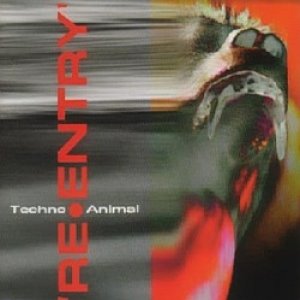
There are albums that impact the fabric of popular music in a way that is lasting, and this was one of them. Nobody ever caught on to JK Flesh's (Justin Broadrick of Napalm Death, Godflesh & Jesu) and KMart's (Kevin Martin, GOD, ICE) albums, and they were missing-out. After hearing their first CD, "Ghosts" (1991), I was terrified!
There are no words for the sonic assault they had on that album, it was very sample-based, and very industrial-sounding (like Throbbing Gristle or Faust). Re-entry has the same feeling that "Bitches Brew" gave me on that first listen--there was a newness that felt like they were looking into the future, and it was exciting. There is a strange trippy utopianism to the electric period of Miles, but Re-entry is dystopian and menacing. Yet, there are aspects of Techno Animal's oeuvre that can even sound elegiac and dreamy, a kind of "flowers in the ruins" quality that's beggars description. Most of the material was done with samplers and computers and is best described as electro-acoustic studio compositions with some live elements thrown-in.
Most of Re-entry has a kind of "noirish"quality that would fit well into the world of Blade Runner. Broadrick and Martin's music has a strange way of making the end of everything seem beautiful and poetic, like the writings of Thomas Pynchon. For this reason, it is very spiritual in an existentialist sense, a kind of musical raging against the abyss that I enjoy. Re-entry has some excellent hip-hop beats and electronics over an ambient soundscape, but you could imagine this stuff blaring over the destruction of Baghdad too. It has the quality of music one would imagine the imperial courts of the Mandarins or the Rajahs had. It's very psychedelic--like a fever dream--a haze of intoxication, often conveying a sense of the pastoral and the arboreal. Some tracks miss-the-mark, but it's an amazing 2+ hours for trainspotters and music addicts. You don't need drugs here, this music is drugs. But if you ever really want to scare-the-shit out of rap fans who play their bass too loud on their rigs, play this very-very loudly around them. The white-noise and subharmonic-frequencies alone will force them leave its proximity.
In the spirit of fairness, I have to mention the other CD of 1995 that is its coequal--Scorn's "Gyral" (Mick Harris, formerly of Napalm Death), an artist who definitely influenced the creation of Re-entry. If I was to describe the Scorn of the mid-1990s, it would be a dub sound with hip-hop beats and sampled-textures (often ambient), and very dark, even Apocalyptic. That's the kind of music that seems to emanate from Birmingham, England. But Re-entry has the same approach to that electric-period Miles, and even a few players who worked with him during that the 1960s-70s. Complimenting this is the legendary Jon Hassell who created his own "4th world music" (a hybrid of electronics, free-jazz, serialism, minimalism, and more). Hassell came out of the "no wave" scene of the 1980s along with Bill Laswell and others.
It's funny how I finally got a copy of Re-entry: it came by-way of Mick Harris himself in 1999. We were trading music through the mails at the time, and Reentry was part of a trade. You couldn't find this album at the time, it just vanished in the US after 1995 just barely making its release through Caroline. Yes, Justin had given the CD to him through the mails--that's how difficult it was for me to find it. Two former members of Napalm Death owned it. I'll never sell it, never! I assume it did much better in Europe, but it wasn't a big commercial success. Again, Virgin records didn't even bother releasing it widely in America even though it was part of an ambient series that included Brian Eno, Hassell, the Orb, and many others. The Wire magazine listed Re-entry in their Top 50 albums of 1995, but musical tastes are more educated and eclectic in the UK than they are here in the US. The UK edition to the Soundtrack to "The Acid House" (an Irvine Welsh story, the author of Trainspotters) has a Techno Animal cut, while the US edition omitted it altogether! That says it all, doesn't it? Artists like Broadrick and Martin are anathema to an industry that has tried to compartmentalize music into genres, and the public also prefers this. With the advent of the Internet, it just seems inevitable that the genres will break down eventually since they're ultimately artificial, and when the original commercial and emotional reasons for them no longer exist, they'll be gone.
The invention of genres and the cult of personality have held music back for a very long time. Music itself has to be organic and ever-changing for it to survive, like life itself, its source. Music cannot stop moving, or it has already died. Like art hanging in a gallery, it has lost its edge and its dangerousness and has been tamed. Something old, something new...I want to hear Jon Hassell cutting-loose over an ambient beatscape with his trumpet some more! These guys are innovators, and they therefore defy categorization which is problematic to lazy music journalists and mainstream labels (the ones that have survived!). Techno Animal folded in early 2004 after a number of failed-attempts at capturing some kind of access to the mainstream, the most notable being their hybrid rap opus "Brotherhood of the Bomb"(Matador records, 2001), which featured heavily mutated hip-hop tracks with seasoned underground MCs. The results weren't that great and neither was the reaction.
Some cuts work, but most of it just didn't click with most rap fans and the North American tour had a very mixed-response. Ironically, the tracks that worked best were instrumentals. Yet, you have to have people like them to achieve any innovations and the music industry knows this very well. Without some form of forward movement, people begin to lose interest (too late!). With no cutting-edge artists being put out there, they start downloading Eminem and copying it to a CDr or an iPod. Or, they finally break down and start making it themselves.
Before you download that album or track, just be sure to pay artists like Justin & Kevin, they've earned that right. At least they're experiencing some success of late--Justin with Jesu and Martin with The Bug (HARD dancehall techno). Someone has to write the soundtrack to the Apocalypse. If not them, why not YOU?
Revised, 08.01.2009
Subscribe to:
Posts (Atom)