Showing posts with label Social Hysteria. Show all posts

Sunday, May 09, 2010

Misinterpreting events on purpose, so you don't have to!


The South Bend Tribune--and I'm not laying the blame entirely at their feet on this one--had an article today titled, "Teens taping fights: 'It shocks the conscience,' " a tale of teen bullying in South Bend (specifically between girls) and the recording of fights on cell phones and camcorders by other teens that are then uploaded onto the Internet for a variety of reasons that even the piece itself misses, or somehow ignores at its own peril. The reporting in the piece is generally very solid by all appearances and journalist Mary Kane Malone appears to have covered all of her bases, but as usual, the analysis and general thrust of it is all wrong, and that's the fault of a newspaper editor.

As a matter of fact, that's usually the case, but it also takes conglomerates reminding editors that they too have a mortgage to pay, so hyperbole it is.

I'm not going to name the names of the victims again and don't think that it was appropriate for the conglomerate-owned Tribune to list them but not their attackers. What is the precise hyperbole, or the hype of the article? This is incredible: the immorality of other kids standing by and recording the attacks/fights on their cell phones and posting them online, ostensibly to inflict more emotional harm and humiliation upon the victims. I'm certain most of these kids were acting in concert with the bullies, no argument there, but why is it a bad thing ultimately? The fact is that it's a good development regardless of the motives of most of the players.

Thirty years ago--and even as recent as fifteen--these acts of violence by children directed towards other children went unnoticed, they were rampant, and adults didn't want to deal with it anymore then than they do now--and that's the real heart of the article. People, especially authorities like principals, parents, police, and even juvenile professionals, don't want to deal with the issue of children inflicting violence upon each other. The trick is to change the subject or the focus:
The video of the fight had gone viral, the girl says, spreading from cell phone to cell phone. In less than a day, it seemed everyone in school had witnessed Chastity's humiliation. Teenage fights now include a new weapon: the camera phone. For parents, school administrators and law enforcement officials, the recorded fights provide a disturbing portrait of teenage violence that, until now, was only seen by those who witnessed it directly. "It shocks the conscience," said Capt. Phil Trent, spokesman for South Bend police. Parents of the victims say they are horrified at the gall of witnesses to flip out their phones and press "record" rather than intervene. But the kids? They call it entertainment. ... (The South Bend Tribune, 05.09.10)
This may or may not be true that it's "entertainment" and they're casting a blanket over the kids generally, as an entire demographic when there's no solid evidence--just a couple anecdotes--being proffered that the phenomena is widespread. Even if it were, how would they know why every kid recording an event was doing so?

But then, the article breaks down and admits that youth experts don't really know why the kids record the fights. Is that really the point? Again, from the article itself, this is the real point (my emphasis): "For parents, school administrators and law enforcement officials, the recorded fights provide a disturbing portrait of teenage violence that, until now, was only seen by those who witnessed it directly." Correct. Until very recently, the technology to record these events in a portable and easy manner was too expensive. Now, there's no running away from the problem since kids are unwisely (or very wisely) posting what is essentially incriminating evidence of children violently and criminally attacking other children. Before, this was impossible, and authorities could only rely on the hearsay of children, a morass of "he-said, she-said" recriminations that were once almost impossible to confirm, to corroborate. That's all changed now.

In short, many of these kids are doing the "right" thing, knowingly or unknowingly.

Some of these kids are alerting the rest of society that there are vicious sociopaths in our midst and showing us their actions. When it's done in the interest of society, of others, it's a very positive social act, a civic duty to report a crime. In the "wrong" hands they're also incriminating themselves and will probably be dragged into the tidal wave of civil suits that are likely to come out of these new technologies of easy dissemination, the power of the Internet writ large, as large as you can get.
"The (bullies) are basically making a recording of the evidence," providing a clear picture of who threw the first punch and how it ended, said William Bruinsma, director of the St. Joseph County Juvenile Justice Center. Police say a videotaped shoving match posted online might be handled differently than one that is not recorded. "The same shoving match, being turned into a form of entertainment by a third party on the Internet is enough to make parents, school administrators and law enforcement" take a second look, said Trent, the South Bend police spokesman. ... (ibid)
It's not about entertainment. It's about adults not wanting to deal with it, but knowing that they now have no choice in the matter. That's called fighting change. In the past it was easy because there was no way to document these behaviors. Now there is. So, yes, the kids have a "new weapon," alright: they can document acts of violence by other children, even under the guise of indirect participation. Indeed, St. Joseph County prosecutor Michael Dvorak "...said video can provide useful pieces of evidence when building a case." Yet, the Oklahoma state legislature has recently made moves that would make posting the footage online illegal and could likely pass it soon.

The article tries--vainly--to suggest through implication that there's an upswing in violence by American girls, something that it has to admit isn't the case from FBI statistics covering 1995-through-2008. You can almost hear the editor of the South Bend Tribune trying to argue their twisted logic and simply capitulating to the facts in the end since they were and are irrefutable, leaving the remnants of the their thought process (if you want to call it that) in the body of the piece. Missing the point is the entire point. Society-at-large has never wanted to deal with the fact that the genesis of bullying in many cases is child abuse, usually by adults, often by relatives. America is hardly the only nation with this problem, and denial is part-and-parcel of the behaviors surrounding the phenomena.

When the economy is already divesting adults of their rights, those of children don't figure highly either. However, children are a powerful moral symbol of the future, the canaries in the coal mine of where we're going wrong with the social contract and where we've been going wrong since time immemorial. Most importantly, the Tribune article commits the cardinal sin of blaming the victim: "But what might appear to be a clear assault on video could have an untold back story, he said: How can police be sure the victim was not the attacker a day earlier in an unrecorded fight?" They never care about that in other circumstances. The real issue is that they don't want to deal with the problem, the real heart of a very poorly-constructed article that carries a sadly commonplace logic in our culture, a culture in denial on most fronts. After all, nobody likes getting caught...

One last thought: should we embed journalists in our nation's schools? It's not necessary. Soon, very soon, the coverage of domestic violence will surpass that of the wars in the Middle East. Think about why.

Sunday, February 14, 2010

On the Tea Party crowd and the tantrum throwing right generally

In reality, they're a tiny minority who don't truly matter, but the economic elites are having their little puppet show with their silly asses before the curtain closes on their mutual dumbshow. Fuck 'em. The economic elites and elements of the poor and working poor are some of the most dysfunctional people in our society and are dragging the rest of us down, it's a fact.

This doesn't fit into the accepted identity politics and victimology, but that's all a bunch of crap anyway. It's not politically correct to say or write it, but since when have I given a fuck? The Democrats? Are they even an opposition party at all? Is there any difference between them and the Republicans anymore?

No, there's hardly any difference these days, and everyone thinks they have all the answers while our rights are being rolled back. I mean, really, it's more important to argue and split-hairs about bullshit while the Supreme Court passes a ruling enabling corporations to spend whatever they want on candidates without us even being able to find out who donated that money, I know. Being right, is being right, and wrong. And, really, quit calling yourself part of "the left" when you don't even know what the fuck it means or where it's been, quit fooling yourselves.

Wednesday, March 11, 2009

"It's a coup!": Some more reflections on the Wall Street bailout reactions


"When small men begin to cast big shadows,
it means that the sun is about to set."
--Lin Yutang

WWW--It was coming from Michael Moore, Naomi Wolf, and from all-points-in-between on the political spectrum back at the end of this last September and October: the bailout of Wall Street was a coup because "we're all being robbed," case closed. That we're all being robbed is a certainty, but a coup? I still keep hearing this weird contention, yet I'm not seeing any proof that any of the players being bailed-out are different ones.

Why should we care if it's the same people? Because that's one of the main preconditions of a coup--someone else has to be in-charge, replacing the last group. What coup? It doesn't fit the definition, yet you have progressives and conservatives screaming one has occurred all over the place. Was there one? Well, yes, ages ago, and they missed it. They're making strange sounds over this, and I wanted to know why, and I've given it a lot of thought and reached a few tentative conclusions.

My belief: people like Michael Moore have had major investments on Wall Street like many of us have had (not me, however!), and that includes folks like Arianna Huffington, Al Franken, much of the wider society, and maybe even a few investigative journalists and media-outlet owners out there. But aren't they begging the question? That was my feeling back in September, and it still is, with a few more historical reflections.

Now, if you lost your ass on Wall Street and you heard that others were being bailed-out--and you weren't--wouldn't you be freaking-out and yelling too? Sure you would, and if you had a soapbox bigger than everyone else's, you'd use it, right? Perhaps. This shouting
that the first bailout of the banks was a "coup" by some of these celebrities across the political spectrum reminded me of someone from our past: Father Charles E. Coughlin, the radio priest.

Today, most Americans have no idea who Coughlin was, but you could say that he was one-part Rush Limbaugh, one-part Michael Moore, and one-part Joseph Goebbels. Yes, this is about the 1930s and the Great Depression, what else would it be about? Coughlin was originally from Ontario, Canada and had confronted a group of the KKK who had tried to burn his church in an act of anti-Catholic hate, so he began with "progressive" and populist credentials. At the dawn of the Great Depression, Coughlin sounded like a voice of reason to many, and they supported him with money and activism. He went as far as founding a short-lived political party, the NUSJ (The National Union for Social Justice), and was most popular with Irish-Catholics during the 1930s, but had a much wider appeal.

Incredibly, he and Gerald L.K. Smith (a lieutenant of Huey Long) could be fairly credited with creating the white supremacist movement. How did it end up that way? From frustrated populist aspirations and a deep disdain for Western-style capitalism. Some people react dysfunctionally to social injustice because they're terminal racists. Where did it all begin for the "radio priest"?

Father Coughlin's American parish in Royal Oak, Michigan began doing radio broadcasts of his sermons sometime in 1926 out of Detroit's radio station WJR, the beginning of the radio age. It has been calculated that Coughlin had a listenership-peak of as many as 40 million, an incredible number for its time. Coughlin was radically populist one moment in his speeches, backing Roosevelt completely one day, and then making remarks totally against the New Deal the next depending on which way the political winds were blowing at the moment. For him--as with Limbaugh--it was all about ratings. In this respect, little has changed since the 1930s, but he accidentally pushed FDR further to the left, so he had some value.

While Coughlin was railing against Wall Street, he was heavily invested in it at a time when almost nobody in the general population
was. Who had money then? Demagogues like Charles Coughlin, that's who; the radio priest was getting rich slamming Wall Street, from his appeals for donations, and his weekly radio program's advertising revenue. Unbeknownst to most Americans, by the mid-1930s, Father Coughlin was one of the largest holders of silver in America. In other words, he was a hypocrite in most respects, and vanity assured his fall. Coughlin began with very enthusiastic support of FDR's New Deal programs, but by 1934 he started having political aspirations of his own and began bitterly attacking Roosevelt and his policies. He also began broadcasting and writing anti-Semitic remarks and began his love affair with Continental fascism and the Nazi State.

By 1938, he reprinted the Tsarist secret police (Okhrana) forgery, The Protocols of the Learned Elders of Zion in his own newsletter, "Social Justice," and was witnessed at a Bronx speaking- engagement doing the fascist salute. It was all downhill after that, as radio stations stopped carrying his programs and the Roosevelt administration moved on him to curb his ability to disseminate first his radio programs, then his newspaper and related literature through the postal system. By 1942, with his support of Nazism all-but-complete, Coughlin became a marginalized laughingstock, and went back to his tiny Royal Oak parish to live out the rest of his life in relative obscurity.

Interstingly, he had connections with a domestic fascist group called the "Christian Front," who plotted to overthrow the government of the United States. He never renounced his connection to them.

I don't think Michael Moore is exactly the same kind of creature as Coughlin, and this isn't some attempt to smear him with the same brush at all, because it's not accurate or fair. But there are a lot of parallels between his life and that of Coughlin, and he's not alone. New communications media have empowered many individuals in the last two decades like never before, and with that access comes the same kinds of issues that arose during the 1930s, a time when radio was first emerging as a force. But the cries of "coup" smack of similar hypocrisies that people like Coughlin once engaged in. One might ask such celebrities like Limbaugh and Moore (or even "conspiracy" writers/activists like Alex Jones) what their holdings on Wall Street are today. You might get a very surprising answer indeed, even with the contemporary prevalence of investment.

Now is definitely a time of demagogues, but the question is: "Who are they exactly? Who are the demagogues?" Rush Limbaugh and most of the right-wing noise machine certainly fit that bill, but there are others out there, right now, waiting for their time. Intellectual honesty is as good an inoculation as you're likely to get, a proactive solution for the ages.

Saturday, November 11, 2006

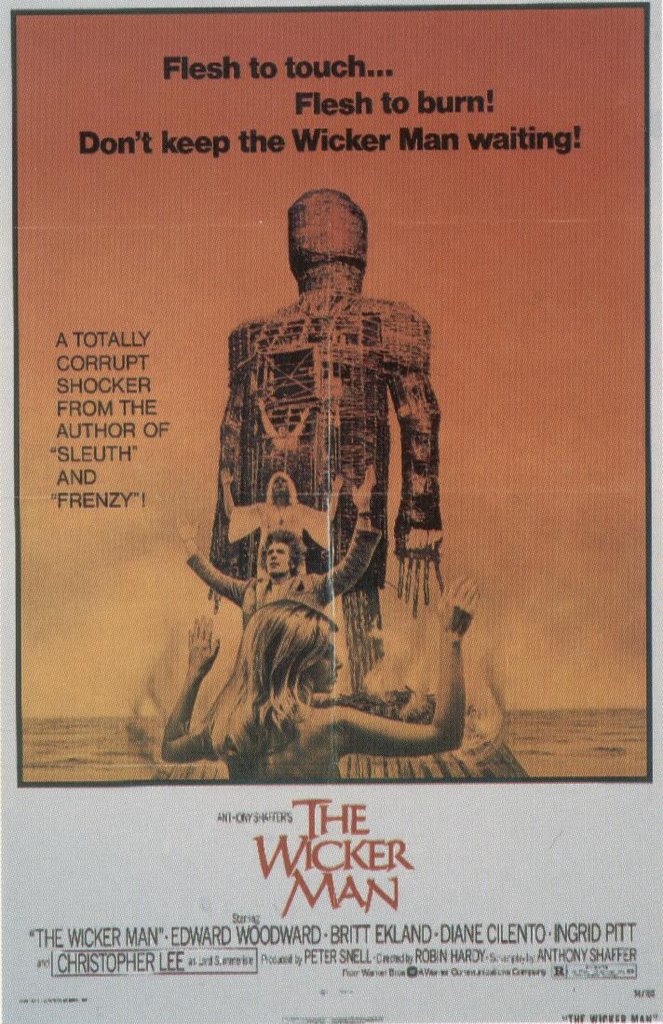
The Wicker Man (1973/SPOILERS) review


'Oh Christ, oh Jesus Christ!'

Christopher Lee is dismissive of a lot of his screen-work, but this is one of his favorites (along with The Whip and the Body). It's hard to call this a horror film, but I guess you could say it is, depending upon who you root for. There really are no villains in this film, and hardcore religionists who would say the pagans who inhabit the island are evil are just flat-wrong.

Western civilization still has its sacrifices in our American death penalty, and in warfare.

Almost every generation is called-up to give of their numbers to Mars and the bottom-line. So-called conservative economists argue that a minimum-of-poverty is needed to maintain the tyranny of consumerism, the New Fascism.

There are sacrifices-aplenty in our 'modern' world, and the results are hardly-removed from pagan-sacrifices, just physically-removed and indirect from our daily lives (what could be more modern?). Oddly, the film is critical of both the ancient and the modern.

No, this is more a thriller with a 'horror reveal' at its climax, as it was originally conceived by director Robin Hardy. Sadly, the producers of the failing UK studio balked at his cut, and we have been left with cobbled-together theatrical and 'director's-cut' versions of the film with many of the scenes and insert-shots restored, but from shoddy sources like videotapes. The original-negatives of deleted material were hidden in a hole on an English country road according to Christopher Lee and others close to the production.

Why? Why did RKO destroy an hour of Orson Welles's 'The Magnificent Ambersons'? Revenge for Citizen Kane, of course. This is done as retribution by some producers, so that a director can never reinsert the footage. Why? Partly because producers cannot usually create movies like a director does, and some of them resent this fact. It also gives them a chance to legally-assert authorship, and thus solidify their ownership of a 'property' based under international copyright laws.

Due to the butchering of The Wicker Man, Christopher Lee has attempted for decades to do a remake, but it appears that this isn't going to happen with him now, and he refuses to discuss the Cage version.


The Nicholas Cage remake can only suffer from this fact, since it doesn't improve-upon the original. It actually does a poorer job, yet has a budget almost twenty-times the 1973 version. The remake basically says nothing-new, and actually takes a very wrong-headed attitude towards women.

Literally 'stealing the show', Lee plays the enigmatic and charming Lord Summerisle, and he haunts the entirety of the Wicker Man until the brutal ending. The other protagonist of the film is the character of Sergeant Howie, who has been sent by the mainland-Police to investigate the disappearance of young-girl on the island, namesake of the Lee character.

This island is Lord Summerisle's domain, and he has re-instituted various pagan beliefs alongside the island's agricultural-base or fruit orchards in the cold and hostile environment of the Hebrides. Temperate fruits aren't supposed to grow there, but miraculously, they do. The cop is entering a world he (and we, the audience) never knew existed. Unlike the remake, I'd say the Summerisle seems inviting and sensual. It's a place you might want to call home. As a stodgy-Christian, Howie doesn't really get this, and it seals-his-fate, creating a nice touch of irony.

It appears the 'new-beliefs' (really ancient, British-ones) are working, for the crops are abundant and the people of Summerisle seem happy and prosperous. There are numerous references to fertility symbols, and the musical-numbers are both inviting and haunting (if not a little goofy), and they lull Howie and the viewer into a complacency (as pagan rituals do to their sacrifices). Seargeant Howie (a daft-name, chosen so the audience doesn't fully-identify with him) is being tested by the pagans for his purity, and the gorgeous Britt Ekland is the bait, though her acting is a bit 'wooden' (or is it 'Wicker'?).

Still, she and her body double add a great erotic flavor to the film that makes paganism seem pretty inviting. Well, unless you're the sacrifice, though believers would likely have no-problem. This then, is the horror component of the film, a non-believer sacrificed by believers in an irrational-rejection of modernity. This kind of romanticism fueled the rise of Nazism, and the burning of the scapegoat.


There are many-reviewers who have said this is about a battle-between paganism and Orthodox Christianity. This is accurate, but there are some nuances to this, and comments on the surrender to irrationality by the pagans and Sergeant Howie.

Let's face it: the cop isn't likable, and we aren't really supposed to identify with-him until the end of the tale as simply another human-being caught-up in something he never wagered on. But that's where it ends. The current version of the 1973 Wicker Man is definitely flawed.

Like a pagan initiation, the story begins as a mystery, both tempting-and-warm, even human. The initiate penetrates more-and-more layers of the mystery of the cult until...you'll have to watch the movie, it is an ending for-the-ages. There really isn't any gore here, just a little-blood, so gorehounds won't like it, but who cares what they think? This is inverted-horror.