Showing posts with label Mortmain. Show all posts

Wednesday, January 07, 2009

A February 2007 email between Deborah Jeane Palfrey and AUSA William Cowden


Ed.--I've held-back on publishing this particular email, and it's overdue. Here, Jeane is practically begging AUSA (Assistant U.S. Attorney) William R. Cowden to look into his heart and consider the nature of her prosecution. It was a pointless action to take, and probably the reason A.J. Kramer left as her counsel, among other reasons related to the core issue of a suicidal client.

In case Mr. Constantine--if I may deign to refer to a parnoiac and spastic twit in such a manner--is wondering, this is just one more piece of primary material that underscores the fact that Deborah Jeane Palfrey committed suicide, that her prosecutors were acutely aware of the possibility that she would carry-out doing the same as Britton had, and that the fight would be a long one. She was good for her word, it was bond. Alex Constantine and several others of his ilk made some very broad statements regarding the issue of Ms. Palfrey's suicide without presenting any tangible evidence. Go figure in parapolitical land. I present some more evidence here, now.

Contacting AUSA Cowden was certainly a naive move on Palfrey's part, and not appropriate for a defendant. But it's what desperate people who are being viciously prosecuted sometimes do, especially when the basis for it is lacking and prosecutorial misconduct is present.

Jeane all-but implies a very dramatic intent by enclosing the February 1, 2007 Baltimore Sun article on the suicide of Brandy Britton, and delivers here, another major suicidal cue. There is a subtext to what she's writing here, doing so without spelling-it-out. What was the public benefit of running Britton and Palfrey to their respective deaths? To protect swinging-dicks like David Vitter from themselves so that they can continue servicing power, naturally. Why did a counterterrorism unit crash into Britton's home during her legal proceedings?

Why did they keep bugging her phones and entering her home without a warrant? Not even Palfrey wanted to know these things; she spoke of Britton dismissively to me, stating, "Let the dead bury the dead."

That we're a "sick society" is a given. All hail patriarchy, burn the witches, ruin the scarlet women, and never allow them to sell their bodies without express and written permission. There were no paragraph-breaks in this email of Jeane's--it's being published as it was originally written and sent...to a dessicated finger on a crumbling, dead hand. The timing of this email is crucial, context being everything. It was "murder," alright. It was murder, facilitated through the misuse of federal law enforcement, a federal prosecution team, illegal-leaks, and the misuse of the federal courts.

This was all done publicly, no "conspiracy" here.


-----Original Message-----
From: Jeanne Palfrey
Sent: Thursday, February 01, 2007 10:25 AM
To: 'William.Cowden@usdoj.gov'
Subject: Jeane Palfrey (US vs. 803 Capitol Street)...

Dear Mr. Cowden… attached please find an article published in this Tuesday’s Baltimore Sun. The parallels although not completely on-point with my case, are nonetheless sufficiently salient. The piece here was forwarded to me by a concerned individual NOT to cheer me up (obviously), but to underscore via the attorney’s remarks the senselessness of my current dilemma, i.e. the tragic destruction/waste of a viable human being. Of course, I cannot and will not expand upon my position/defense in this correspondence without benefit of counsel. I understand theinappropriate nature of such an act. In fact, I fully appreciate the inappropriateness of this communiqué and equally comprehend your ethical duty to “report me” to both Mr. Sibley and Mr. Kramer (I am braced to deal with their wrath). However, before matters compound even more and perhaps irrevocably so, I must take this opportunity to ask that you and your colleagues take a very hard look from a moral stance, if none other at the matter at hand. I know for a reality others certainly will question the justification for this effort to prosecute me. The publicity generated from the unsigned search warrant posted on the online tabloid rag www.thesmokinggun.com alone last October, gives testament to the interest and subsequent scrutiny a high-profile case like mine spawns. When Googled, the coverage at its height was seven plus pages. And the only reason the publicity online (exclusive of other media at the time– ‘Inside Edition’, ‘Hard Copy’, local news – here and there - and a myriad of news organizations and newspapers, nationally AND internationally all in hot pursuit of me) was kept to a mere seven pages was because I evaded everyone/anyone after being apprised initially of the situation (ironically from The Smoking Gun) while in Germany. It also should be noted the initial coverage last fall was based solely upon one side of the story and correspondingly did not bode well for me. As we all know though from life’s adventures, there is always a flip side to every coin and surely in time, this other side will be reported in the more legitimate press. Again, I realize the anomalous nature of writing to you. And I apologize for any discomfort this may cause you. Regardless, I simply cannot emphasize to you the terrible and quite unnecessary ramifications this case (civil and/or criminal) will set off, if permitted to advance for both sides. The press will have a field day at each of our expense. Despite my aforementioned disclaimer not to comment upon my case, let me say this. The attached item rings more true than false when juxtaposed to my situation. Unlike Ms. Britton however, I am ferocious fighter when need be. Knowing my intense makeup as I do, far more than even my attorneys comprehend at this juncture and my belief in the solidness of my case, I can state with unequivocal certainty this situation will be a very long and unpleasant one; this despite, the sickening and humiliating additional lambasting I expect to receive in the media. Please reflect soberly upon my various thoughts, here. This is all I ask. –Sincerely, Jeane Palfrey

The February 1, 2007 Baltimore Sun article on the suicide of Brandy Britton: http://www.scapa-lv.org/news/Former_professor%27s_tumultuous_life_ends_with_suicide.htm


Wednesday, December 17, 2008

What is the extraordinary nature of the Blagojevich scandal?


"I can't wait to begin to tell my side of the story and to address you guys and, most importantly, the people of Illinois. That's who I'm dying to talk to."--Standing Illinois Gov. Rod Blagojevich.

Chicago, Illinois
--These are truly momentous times, a real threshold moment in American history. The Illinois Supreme Court's rejection of
state Attorney General Lisa Madigan's filing to remove standing Governor Rod Blagojevich is a stunning example of a political and economic order on the ropes. It raises the specter of a power-vacuum and the continuation of a vicious Machiavellianism at the heart of American politics. In other words, intrigue.

Is that what's happening in the Blagojevich scandal? It wouldn't surprise anyone except maybe a High School teacher, the last to know what's going on at City Hall.

U.S. Attorney Patrick Fitzgerald's case that the Governor attempted to "sell" Barack Obama's senate seat and did so actively in what he's called a "corruption crime spree" looks good on paper, it's convincing, but his outrage over things like how many times and permutations Blagojevich said "fuck" smacks of character attack and over-zealousness. Welcome to Chicago, Pat.

Coming from the Chicago U.S. Attorney, you'd be led to believe that Blagojevich was Rasputin and that his downfall was virtually inevitable based on the evidence he claims to have on him. Fitzgerald made similarly broad claims with the Plame case, winning a minor conviction on I. "Scooter" Libby, former chief of staff to Vice President Dick Cheney which was quickly commuted by President Bush. Go team (boo team, you lost, you promised more than you could deliver).
Genson said it would be "frankly illegal" for the committee to base an impeachment recommendation on the criminal complaint against Blagojevich. The complaint doesn't provide full conversations and context, he said, and it can't be cross-examined like a witness.

Rep. Jack Franks, D-Woodstock, challenged Genson to have Blagojevich testify.

"If we want the facts, we should have your client here. If you want to get to the facts, let's bring him here, let's ask the questions," Franks said. ("Attorney: Ill. governor won't fill senate vacancy," AP, 12.17.2008)

The federal investigation appears solid on the surface, but did Blagojevich and others close to him really take affirmative steps towards the completion of a crime? Why the rush to judgment? Did they (Blagojevich and others) technically break the law merely by talking about something but not taking any substantial actions towards completion? Is this a case of wishful thinking?

Blagojevich could have a very good case here. His counsel, Ed Genson, has raised some very good points because there's a strong possibility that no substantial steps were taken towards completion of the crime, just a lot of [expletive deleted] talk.

Context is everything in a criminal case (let alone a political one), and we have yet to see it in the release of the wiretaps. What were the comments before-and-after the ones released by the U.S. Attorney's Chicago office? What other evidence is there? Is the investigation near completion? Is the Governor still being wiretapped? What role did informants play in this, like Jess Jackson Jr.? Is Blagojevich's counsel currently being wiretapped? Since the investigation is not currently over, on what legal grounds should anyone claim the right to remove the Governor?

These are just a few of the questions that should be addressed by the prosecution, the GOP, the DNC, the Obama campaign, and Blagojevich's detractors in the Illinois State House and Senate, and within his own office.

These people need to state their case clearly, the onus being on them in our legal system. At this writing, Blagojevich's attorney has announced that the Governor will not name Barack Obama's successor in the senate, answering at least one question in this whole mess.

This chaos and loss of faith in icons of authority and power all reminds one of the last days of Tsarist Russia. I can hardly wait to hear what the Governor has to say in his defense, I'm dying too Rod. Will it include revelations about someone who arouses just as many suspicions of corruption, one Rahm Emanuel?

U.S. Attorney Fitzgerald might discover that Blagojevich and Emanuel share a similar vocabulary, both politically and linguistically. He had better hope he's right, but procedure that gives deference to government investigators and prosecutors could shield him if this is so. Whatever happened to due process?


Wednesday, January 09, 2008

Lucio Fulci's The Eroticist (1972) review


Cardinal Maravigli: "You can make the presidential palace a brothel as far as I'm concerned, just do it once you're president!"

Most movie fans cringe when they hear the name Lucio Fulci. They think of rotting zombies and guts spilling everywhere in a lake of gore and putrescence. Fulci made around 58 individual motion pictures from 1959 to 1991, and it's only in the final quarter of this body of work that he made the horror films he's known for throughout the world. But what about the earlier ones? Few ever made it out of Italy at the time.

What's surprising--or not considering one's take on comedy and horror--is that the great majority of Fulci's output were comedies. He also directed a number of spaghetti westerns, a Jack London story (White Fang with Franco Nero,
and some of the best giallos ever lensed like A Lizard in a Woman's Skin, The Manhattan Ripper, and Don't Torture a Duckling.

The truth is, there were many sides to Lucio Fulci.

"The Eroticist" is one of those movies whose images never leave you, which is quite an achievement for a social and political satire wrapped in a sexual farce! But it's not that difficult in the hands of such a skilled director as Fulci and the flesh parade of Laura Antonelli, Anita Stringdberg, the handsome and hilarious Lando Buzzanco (as the senator), Agostina Belli, and a gaggle of nunsploitation sex-pots. It doesn't need to be repeated that the 1970s were that "decade of violence" in Italy, but the Eroticist is a good reminder of how absurd and explosive Italian politics were at that time.

Fulci created this story and co-wrote the screenplay with two other writers, Alessandro Continenza and Ottavio Jemma. Making this film in Italy in 1972 took guts, something Fulci had plenty of, he was unflappable. The Eroticist is a film that's both blasphemous and sexually redemptive besides being a very pointed political satire. You don't have to be familiar with Italian politics to understand it.

The story is fairly simple: an Italian Christian Democrat (as in Germany, the party the fascists joined after the war) senator named Gianni Puppis (the square-jawed Lando Buzzanco) is heading for the "highest office in the land," the presidency of Italy. Puppis has been so caught-up in his rise in politics that he's never had sex--and yet he's still Italian. This being a slam on Italian politics and politics in general, viewers might think that senator Puppis might seem demonically possessed as part of this delicious sexual farce, but he's not, and that's what makes this a movie that speaks loudly to our own scandal-ridden era or any other modern era. Hypocrisy is universal.

Senator Puppis is, simply-put, just a very horny man in a profession that doesn't allow for it. His only alternative is to head towards life, leaving the old one behind. This is something he struggles with, and the results are uproariously funny. Fulci even patterned Buzzanco's appearance after a real Christian Democrat senator!

Yet, the senator isn't possessed by anything unnatural--we find--it's just that he needs to get laid. He begins by subconsciously engaging in some grabb-ass at public events he has to preside over! On one occasion, he grabs the ass of the president of India! Enter Fulci's favorite target: the Vatican. For anyone even mildly acquainted with Italian politics, one knows that the Church is that constant irritant blocking as much progress as possible and that they still meddle in the elections and the ways of life and government of a nation.

Whenever you see a zombie in a later Lucio Fulci horror, it's a reference to the "dead hand" of the Church, the Italian curse. Fulci--to his credit--hated the Vatican as most reasonable people do, and they get special treatment here. Puppis is the Vatican's and the Sicilian Mafia's man. The Vatican is represented by Cardinal Maravigli (played by American actor Lionel Stander, the guy with the croaky-voice from tv's 'Hart to Hart'--he was also in Polanski's forgotten "Cul-de-Sac" and Spielberg's "1941").

And so, we get one sexual escapade after another, a kind of "what's he going to do next?" comedy. Will the senator be able to control himself? Will his handler, Cardinal Maravigli be able to watch him and keep him out of trouble until after Puppis has won the presidential elections? Sending Puppis to a convent filled with German nuns doesn't work--he has sex with all 21 of them, and why not? Far from being the sexless "fag" that his political rivals thought he was, il senatore is making up for lost time in a big way. Embarrassing? Si! Better for the body and the body politic? Si!

There are so many hilarious and embarrassing moments of sexual humor here, and as usual, the photography and composition are as luscious as they are in even the goriest of Fulci's work. Will senator Puppis win the presidential election, or will he decide to be a normal man with a normal and healthy sex life? He cannot have both. Fulci seems to be saying that one cannot truly live when one focuses their life purely on the pursuit of power and influence. Sinning, then, is normal and human, a better path.

Regardless of religious repression, the forces of life prevail. The Eroticist also says a lot about why we think our politicians shouldn't have a good sex life (considering how they behave, it could be a
torture that is earned ), but attitudes towards this have changed substantially in Europe, and certainly in France. Still, the Church has its undying influence...

Wednesday, October 18, 2006

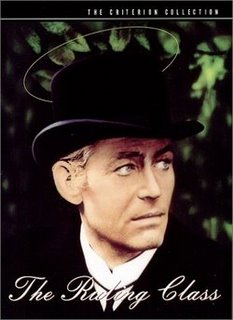
The Ruling Class (1972) review

Could there be a film crazier than Marat/Sade (1966)? Yes, it is the O'Toole/Medak/Barnes collaboration from 1972, 'The Ruling Class.' One could be forgiven in thinking this was a Ken Russell film, but it isn't like he was alone in making blistering-cinema during the late 1960s, early 1970s. We will probably never see an era in movies like this again, it was so free and unfettered by the studio system that it pushed the envelope forever (only to have what is acceptable in commercial cinema recede again). Many viewers would say this kind of film is overindulgent, but that is entirely the point. The Ruling Class was originally given an 'X' rating in the UK in the 154-minute cut, but was released with 20-minutes removed in the American PG-version.
The 2001 Criterion edition is the first time the film has been widely-available in this original cut as it was shown at Cannes. There is no better edition, it is perfect, and a must-own for anyone who loves serious cinema.


The story began as a successful 1968 play by Peter Barnes, and it was considered bizarre for its anti-naturalism, as well as the comments on the English aristocracy. If I describe much of it, the effect will be ruined, but there are musical numbers in a movie that is not a musical (similar to Brecht here). Similar to Artuad's 'theater of cruelty', the approach is to alienate the audience in particular moments--sometimes throughout the entire piece! This was common in the cutting-edge cinema of the time, just watch A Clockwork Orange (1971), Ken Russell's The Devils, or even Midnight Cowboy (1970). Barnes rewrote the screenplay with very few changes, but don't think that the O'Toole/Medak version is simply a filmed play. It is not, it is much more than that.
At once, a parable on the folly of belief systems, it has much to say about the flimsy glue that is the ruling-class anywhere. Some hierarchy is inevitable in this life, but do we want crazy imbeciles running the developed world? And what of psychiatry or academia? Both are beholden to their own class assumptions, as The Ruling Class amply illustrates. Oddly, it is all about the end of all belief, a hallmark of the time it was made in.


The story is pretty strange, yet plausible: the 13th Earl of Gurney (Harry Andrews) has accidentally hung himself in an act of autoerotic asphyxiation, a monologue/prologue scene that lasts over 15-minutes! It's riveting, nonetheless. With the old Earl dead, there is only one heir left for the Lordship of the Gurneys: the Earl's crazy son, Jack (O'Toole). Jack is completely insane, and thinks he is Jesus Christ, messiah and savior of the human race. The would-be Lord is a paranoid-schizophrenic. He is so insane, his speech patterns betray him immediately. He has constant tics, and flights of fancy that defy words, and make this the finest performance by Peter O'Toole in any film (it's his favorite of all of his film performances). 

The performance was nominated for numerous awards in 1972. He really is a sweet character in the first half of the film, and shows some wonderful humanism that is lacking in the rest of his kin. His only conscience is the butler (James Villiers), a closet anarchist! His character recedes as Jack becomes...even more oddly different.
With Jack insane, his uncle Sir Charles (William Mervyn) sets-out to get him declared by a German-psychiatrist he has hand-picked...or has he? It appears that his sister, the Lady Claire Gurney has had an affair with the analyst, and has other-plans for Jack and the whole situation. But Charles has decided he can control Jack through a call-girl he has groomed as the heir's wife, a Grace Shelly (played by the super hot Carolyn Seymour). They are eventually-married by the very reluctant Bishop Lampton (the legendary Alastair Sim!), a distant relative in the Church of England. In such an environment of intrigue, being a paranoid-schizophrenic would be a natural reaction, so one is struck by the fact that being one of the 'ruling class' means to be eventually driven mad. The jokes are biting in this one, with some of the best retorts I have ever heard! To sum it up, the factions are battling for control of the estate through Jack, who is 'J.C.' in the first half of the film. The German psychiatrist finally decides he can cure the would-be Lord with a radical-approach: he finds another madman (the 'High-voltage Messiah', an insane Scot played unforgettably by Nigel Green) who thinks he is God, and puts them in the same room together. It should be noted that Green died after the end of shooting from a barbituate overdose.


This approach of 'two gods in one room' actually has been attempted in psychiatry before, but it usually doesn't work; the delusions are impenetrable. The problem is, the High-voltage Messiah thinks he's the Old Testament God of Wrath and destruction, and it causes a crisis in Jack's version of Jesus, destroying it utterly. You could say that both characters embody the Manichean mythos, and that they hold a heretical view of religion. The High-Voltage Messiah represents the 'demiurge', the blind idiot god of gnosticism, while Jack represents gnostics who believe in the Christ within. Previously, Jack has denied his name as part of his illness and just wanted to be someone else. This is interesting, since early Christians often were given a new name upon entering the cult. Unfortunately, this warmer Christ personality is gone after the treatment, and all that is left is the Old Testament God, and so, Jack takes on the role he was destined to all along. 'I'm Jack, I'm Jack,' says the future Lord, and the psychiatrist and the family think a cure has occurred. 'I'm Jack, alright...Jack the Ripper,' states O'Toole in a moment of hilarity and horror. Instead of the Prince of Peace, he's begun advocating bringing the 'noose back to England', and nobody in the ruling circles notices him as odd anymore. It's really sums up the tone of the film. Most unsettling is the image of the German psychiatrist carrying a cardboard-cutout of the murdered Lady Claire around, yelling 'Cock-a-doodle-doo!'


It becomes clear that Jack is going to be the quintessential 'Lord of Old', a murderer and a punisher, a warlord and an ancient patriarch who kills his children to feed the bloodlust that is at the heart of the will to power. Nobody will be controlling Jack: the butler is off to prison, Charles and the Bishop are off to a nursing home, and the rest had better watch their backs. He dispatches a few of them forthwith. There are a number of scenes that are expressionist: we see some of Jack's hallucinations, such as when he murders Lady Claire in an 1888 Whitechappel-setting, or when he comes to the House of Lords for the first-time--he sees all of his peers as rotted, animated corpses, intercut with what we see. Jack views reality through a poetic lens, nonetheless. 
This latter scene speaks volumes of the undead nature of ruling institutions, and used to be applied to the Catholic Church; it is a Medieval notion. But, it could apply to the aristocracy of Great Britain, which seems to be eternal. It should be noted that the film is a great technical achievement in cinematography and composition. There are also very creative applications of sound elements that aren't related to the images, which are very effective, and are reminiscent of similar techniques in Midnight Cowboy. Bizarre, sexy, unsettling, entertaining, thought-provoking, and classic. The ending? There is no end to this story.