Showing posts with label Karl Marx. Show all posts

Thursday, September 10, 2009

GOP Rep. Joe Wilson, douchebag


WWW--You'd think last night's speech took place on April 10, 1861. Huh? Yes, the moronic big health recipient shot his mouth off last night during president Obama's speech on health care reform as though he was Brigadier General G.T. Beuaregard, shelling Ft. Sumter--only this time, he didn't take four long years of fighting to "apologize."

"You lie," he stammered in crackerese, and it was the come shot heard around the world--or at least in the halls of Congress and the boardrooms of big pharma and the hearts of the insurance robber barons. "Render unto Caesar" never meant going down on him--after all--and Wilson's Caesar salad, his masters, are corporate and plutocratic ones. It really had nothing to do with immigrants getting health coverage at all.

A longtime friend said to me a few months ago something that I take to heart and consider very seriously (I'm paraphrasing him) : "Southerners--in general--are intellectually incapable of functioning in a democracy." I agree with this strongly. My family on my mother's side comes from Kansas and Arkansas--they left for a reason, and the aforementioned was a large part of that reason, or the lack thereof. There was nothing to stay behind for at the end of WWII, and it wasn't just about jobs, it was about a backwards culture that doesn't want to change.

Wilson's inappropriate outburst was a pathetic violation of decorum and I believe strongly that its intent was symbolically racialist, not merely because he's a whore who's owned by the insurance and big health care-related corporations and trusts. I believe Wilson was put-up to what he did by his own party because of the state he's from, a place dear to the heart of sundry evangelicals and the emotionally retarded throughout America since it's where the American Civil War stupidly began, and it was over another lost election, what Marx called a "slaveholder's rebellion."
The white-trash South is going to be that red-headed stepchild of America for as long as the air is breathable and before the planet really starts hitting back. But Marx was correct: the Civil War was childish, regressive, and anachronistic.

Indeed it was, and there was nothing noble about it, the Confederacy-be-damned. There's a better word for what the firing on Ft. Sumter and Wilson's outburst constitute (or rather, don't): the childish throwing of a tantrum, a fit by the mentally-challenged. Apparently, South Carolingian didn't find their governor Sanford embarrassing enough, so they elected a whole gaggle of losers from the Fellowship. But wait, it gets better, much better.


Wikipedia has had to put a lock on Wilson's page, similar to what happened with Sen. David Vitter's page when I and others were attempting to add pertinent information to it that was factually correct. I know, unfair, especially when someone's powerful, then it's heretical, a travesty. But, never mind, these pages of the unaccountable powerful have hired gatekeepers (some simply acting on their own) who act like sleeper agents to guard them and block further content that might be deemed (by them) "controversial." Before all that, I never cared for Wikipedia, never respected them, and never will, they're redundant, go use academic sites for information.

Wilson is the poster child of a dysfunctional democracy, but then, so is the entire GOP and most of the Democratic Party. Their constituents? A foregone conclusion, but at least most of the dumbbells out there are going to get a very painful civics lesson. No, Joe Wilson never lies, and he never chopped down that cherry tree, since it never existed anyway. To be sure, the GOP and morons like Wilson are speaking in a coded language predicated not only on plutocratic criminality, but also a regressive race-baiting. In other words, Wilson's going to be "out-niggered" before long, expect the language to coarsen. Racism is flushing itself out behind the facade once again, which is a good thing. It's easier to hit it once it's out in the open, the tipping of the hand, the curse of the terminally stupid.


Saturday, February 28, 2009

Winner of the "Oops! I Spoke Too Soon!" Award, Dr. Francis Fukuyama


"The distant origins of the present volume lie in an article entitled “The End of History?” which I wrote for the journal The National Interest in the summer of 1989. In it, I argued that a remarkable consensus concerning the legitimacy of liberal democracy as a system of government had emerged throughout the world over the past few years, as it conquered rival ideologies like hereditary monarchy, fascism, and most recently communism. More than that, however, I argued that liberal democracy may constitute the “end point of mankind’s ideological evolution” and the “final form of human government,” and as such constituted the “end of history.” That is, while earlier forms of government were characterized by grave defects and irrationalities that led to their eventual collapse, liberal democracy was arguably free from such fundamental internal contradictions" --Dr. Francis Fukuyama, in his introduction to his book, The End of History and the Last Man, 1992.


Yes, what a moron he was and is, but that's a given. Fukuyama's been spreading the love since 1992. Would he really know democracy if it bit him?

But even at that time, it was becoming obvious through developments of the successful Zapatista uprising, the subsequent rise of the "anti-globalization movement," the "Battle for Seattle," the rise of an unending proactive antiwar movement, new forms of resistance and theory arising throughout the globe to neoliberalism (notably in South America in the last decade where it has been rejected almost entirely), and so on, that Professor Fukuyama couldn't have been more wrong. He still is wrong, as is his wont, and he isn't going to be satisfied until he has no reputation left but that of a laughingstock. Mission accomplished--time to retire along with George Lucas.

Fukuyama was defending himself even when his book version of The End of History was released, with the author even going as far as to use Marx and Hegel as a shield in the above introduction. That they posited some "end-point" to human social and political evolution--the evolution of ideology--is well known. On this point, he's correct, and he shold have enjoyed being right, at least for once. Yet, Marx and Hegel were never so brazen, ignorant or insolent as to claim when that end-point time would actually come, and it's clear from their writings that it would probably take centuries, if not millennia. Never mind all that: someone's paying the bills, and it's good business to agree with oneself.

No, Marx and Hegel weren't being paid by a bunch of rich capitalists (although the factory owning Engels could fit into that category, he was headed in another direction...) to be one of the shrill voices during the fall of a global power (the Soviet Union) lauding the invincibility of another global player (American style economics, themselves). People like Limbaugh, Gingrich, and Fukumaya were drunk on their short-lived "victory" over the ending of the Cold War and their plans to take Capitol Hill "permanently," if not the White House. Sober minds in the Kremlin warned, ominously, that the United States would fall as a power after the Soviet system. They were right, and now we find ourselves where they were twenty years ago: Afghanistan. The warning signs have been flashing for decades, but never so brightly as now. But power is tone deaf.

As should be common currency by now, power corrupts, and that was the voice speaking from the well-fed yob of Fukuyama back in the 1980s-90s. His utterances in the present historical moment don't show any sign that he, his class (academic historians of all sorts), or those he serves, have lost any of their lust for power for its own sake. That he's looking like even more of an ribald ass now than he did at the time of 9/11 is a given. When you don't have the truth on your side, you resort to jargon and jingoism, and that's about all that Fukuyama and the so-called conservative side of the fence ever had besides the willingness to use barbarous violence to impose neoliberal/Reaganist capitalism on the rest of the world. You lie, rhetorically, throwing out the words "Liberty, Fraternity, Equality," and other myths regarding our way of life.

What does any of that have to do with "liberal democracy"? Nothing, it's just rhetoric on their part, and the new president surely shares many of their assumptions. But things have changed.

Now that America's dominance is slipping--most importantly, on the economic side--it appears that history is far from over, not even by a longshot. At best, Fukuyama's writings on whether the historical development of ideologies have ended are political-philosophical tracts written by a conservative hack on the payroll. In the future--if we're left with one thanks to people like them--they'll make for a very humorous read.

If you've actually ever read Adam Smith's The Wealth of Nations, you know that one of the central tenets of the book is that all nations have their time at the top, but that history deems there is a time when that dominance ends economically. Contrary to what many are saying, America doesn't have to suffer under this cycle--quite the contrary. Without all the unnecessary expenditures revolving around an empire, the average American will have lifted a very heavy lodestone from their neck. As a result of the ending of empire, illegitimate control over their lives by domestic elites will be severely weakened. The power structure in America is under serious threat, caused by their own hand.

What comes next is the groundswell of people demanding a better life, which isn't always a pretty or even tidy affair.

This is why we saw the passing of so much repressive legislation under Bush II and why most of it isn't going away anytime soon. Far from being a "coup," American elites are doing their best to hold onto power, and castles have a dramatic way of falling (watch your heads). History is over? Tell that to the people of Iraq and Afghanistan and tell it to the average American solidier or military contractor on the ground. They might point to the dead and ask, "What's that?" Dr. Fukuyama should be taken on a tour of our torture and rendition facilities to ask inmates whether they think "history has ended," and he might also take a tour of South America today and ask the leaders of those nations whether they think history has ended.

He isn't likely to get a positive answer, but probably more than a few laughs at his expense again. Laughter is the summation of his legacy. Fukuyama realized this--belatedly--in his boring and lie-ridden October 4th, 2008 oped piece titled, "The End of America Inc.":
All this suggests that the Reagan era should have ended some time ago. It didn't partly because the Democratic Party failed to come up with convincing candidates and arguments, but also because of a particular aspect of America that makes our country very different from Europe. There, less-educated, working-class citizens vote reliably for socialist, communist and other left-learning parties, based on their economic interests. In the United States, they can swing either left or right. They were part of Roosevelt's grand Democratic coalition during the New Deal, a coalition that held through Lyndon Johnson's Great Society in the 1960s. But they started voting Republican during the Nixon and Reagan years, swung to Clinton in the 1990s, and returned to the Republican fold under George W. Bush. When they vote Republican, it's because cultural issues like religion, patriotism, family values and gun ownership trump economic ones. ("The End of America Inc.," Newsweek, 10.04.2008)
In other words, the right has used cultural flashpoints as phony issues to sway a healthy chunk of American workers away from servicing their own economic and political interests. Europeans tend towards the left because of centuries of struggle by the average person, two devastating world wars that made it clear that a lasting peace could only come through social justice, better educational systems and traditional systems and networks of resistance that have no analog in the US, and because there was an incredible loss of faith coming from the fall of the traditional monarchies after the wars of the 20th century. America has experienced little of this, partly due to how young it is as a nation. If it's broken, don't fix it.

Like America's business class, the Monarchies had used religion as a weapon to control the masses, and they fell. Again, America doesn't have the same historical experiences, but these things have a way of playing-out similarly, these all being human systems of social organization rather than ones from Mars or Jupiter. Once the Monarchies were delegitimized, religion fell into disfavor throughout many parts of the European Continent. It's quite possible that the same could happen here, and for similar reasons.

In the 1980s and 1990s, it was the job of people like Dr. Fukuyama to drive people away from working towards their own interests by deceiving them with false invocations of patriotism, religion, "family values," and sundry other Shibboleths. That no longer works when the system crashes under its own in-built paradoxes, and the public correctly moves towards the left (or, more accurately, away from authoritarian thinking) because it's natural to do so in the "correction" part of this historical cycle. If there are no corrections, there is no recovery, a word to the wise who are wishing very vocally that President Obama's economic stimulus plan fails--then what?

Ultimately, the only thing Fukuyama could do in the fall of 2008 was to finally start covering his ass, and to do it as substantially as he could manage. How sweet it was of Newsweek to pay him for his services rendered. He might want to convert it into non-perishable foodstuffs and gold. Do he and his ilk really believe in anything at all besides power? Unfortunately, yes. We might find that at the heart of Reaganism there always contained more than a hint of the death wish and nihilism, especially when power isn't achieved, is under serious threat, or is lost altogether. False conservativism's implicit logic can be found in the writings of Dr. Fukuyama, a logic that offers no future at all.

"The End of America Inc.," Newsweek, 10.04.2008:

Thursday, November 20, 2008

Why should we trust former Salomon Brothers banking investor Michael Lewis?


"But what has been the experience of the Russian socialist movement up to now? The most important and most fruitful changes in its tactical policy… have not been the inventions of several leaders and even less so of any central organizational organs. They have always been the spontaneous product of the movement in ferment… In general, the tactical policy of the Social Democracy is not something that may be 'invented'. It is the product of a series of great creative acts of the often spontaneous class struggle seeking its way forward." --Rosa Luxembourg, "Leninism or Marxism," 1904.

New York City, New York
--As you can imagine, this guy exists in a strange place as a former investment banker, now turned business journalist and author.

Lewis wrote Liar's Poker in 1988-89, a book that many are now going to say was very prescient upon its release just 19-years-ago. It isn't.

Time flies when you're having fun.

Just a few hours ago Lewis was hawking his newest book on CNN, those scions of bad taste and oversimplification and over-concision. CNN's talking necks were having their lovefest with Lewis over how credible and wise he is. Is he? I don't think so, and as low as my opinion of the public is, I believe we all knew the crisis was coming. That said, I think the feelings that mainstream journalists and writers harbor within their breasts eclipse my own intense misanthropy and ambivalence towards the average American, let alone humanity. These journalists and pundits believe that they have the answers and the rest of us are too stupid to understand things as well as they do because they were educated to think that way.

Their elitism comprises a truly delusional contention: "We have all of the answers, so shut-up and let us drive." Paradoxically, it's "ordinary" people who tend to save the day throughout human history when the politicians, the businessmen, and the intelligensia have failed everyone (as is their wont, they can't help themselves). We clean-up the mess, and we're doing it right now on Wall Street. Listening to the public on-occasion might help.

Those who could have prevented the current economic crisis were the root of the problem and still are, though their own collective fall is coming soon. Instead of just blaming borrowers who defaulted, we should also be asking, "Who allowed it?" and "How many of the loans were even legal?" We know the sales of the bundled securities were not, it was a matter of fraud and deserves further investigation. Some are occurring right now. Many of us raised the alarms, but we know oversight and the enforcement of key regulations over the financial sector weren't going to be expedited under the Bush II administration and GOP dominance.

The financial and business sectors were told that they could do whatever they wanted up-to-a-point and that nobody was going to be watching. Who told them that? The negligence in not enforcing these administrative laws is corruption, contrary to the comments of the apologists. Is Lewis one of them? Like CNN and the rest of the dying media, he won't discuss the corruption, and I'd like to know why.

So, what did Lewis have to say on CNN? That this economic crisis "wasn't the result of corruption" (what else?) or outright dishonesty, but that it was a result of delusional behavior predicated on--don't laugh--everyone "doing the right thing" on Wall Street. This is an incredible statement in the current context, but at least he sees the writing on the wall--things will never be the same and the old Wall Street is dead. However, as you can imagine, the assertion that "everyone did the right thing" made no sense to these eyes and ears, and I predict that these assumptions of his and the rest of them on Wall Street are headed rapidly towards the dustbin of human history.

No, according to Lewis, it was "conflicting interests" that caused the current financial crisis, which again, points to corruption. The banks and mortgage leders have been ripping each other off, and now they won't lend amongst themselves. Right, greed and dishonesty. Lewis seems to be arguing for transparency--granted--but he still clings-to the same old faux-values of Wall Street. Like a lot of people on television and politics, he said a lot without saying much at all, so I switched over to Anthony Bourdain, a man with an attitude I admire, then switched-back again to feel the numbing-pain of boredom for kicks, it's a real rush.

Lewis went on making some bizarre statements that "corruption wasn't a factor" in the crisis--it was generally that the system that ran the financial markets was predicated on illusions and mass-delusional psychology. No kidding? How did that happen? Who made them think they could keep doing the same wrong things without it coming-back to haunt them later? In many cases, themselves, silly. After all, the (wo)man who hears God is usually listening to their own voice.

Additionally, Lewis has written and spoken elsewhere that these financial institutions and their CEOs simply "didn't know what they were doing." Fancy that. No argument here, I don't think that they ever did know what they were doing or ever will. The past economic order and its faulty assumptions were systemically wrong, inefficient and top-heavy with that favorite word of Libertarians, conservatives, and the GOP: bureaucracy. Forget government, the corporate world has them beat on redundancy. The managerial class itself has amply displayed their greed and dishonesty over the last 30 years, therefore it shouldn't surprise anyone that we ended-up where we are today.

It took others to create this mess, there was a lot of enabling from every sector, such as investors who were clamoring for greater and greater dividends, irresponsible borrowers of every class, and so on. But the runaway borrowing was allowed. Like my former employers--a small retail outfit that's sure to close soon--the speculators and financial institutions only knew how to ride an economic boom that's part of the traditional boom-and-bust cycle of our flawed economy, much like a Gold Rush. Eventually, inevitably, the veins run out and the towns die. But a lot of the public was either apathetic from years of being beaten-down, or they bought into it (and boy, didn't they?). Not everyone got on-board, just enough to wreck things.

Let's be honest: this was also fostered by that "invisible hand" of pro-business legislation passed by politicians who know better, not just the misbehavior of Wall Street. This is also known as "deregulation," but far-be-it for anyone to criticize the sacred, the inviolable St. Ronald Reagan and his Maoist cult that hijacked traditional conservatism in the 1980s. That's over now, but this greed-based stupidity allowed the markets to run amok for over two decades because the folks in Washington know who's really boss, and it's not them, it's the business and financial community and ownership.

Like my former employers, these clowns got a taste of power and lost their minds thinking that they were untouchable, that they were God. Their bulging-guts and the fact that they defecate daily (phew! you don't wanna know) should have been all the reminder they needed that they weren't. Now they're all finding-out the hard way, which is where my well-earned schadenfreude comes in...

Beyond my own feelings of glee over the suffering of scoundrels, Lewis isn't saying anything new here at all (which he accuses others of doing in the Conde article). Writer Charles Mackay dedicated three of his sixteen chapters of "Extraordinary Popular Delusions and the Madness of Crowds" to financial-bubbles titled "The Mississippi Scheme," "The South-Sea Bubble," and "Tulipomania." Mackay's book was originally published in 1841, at a time when Karl Marx was an unknown doctoral student. What did Marx do when he couldn't find a job in academia because of his radicalism? He became a journalist. Life is like that sometimes, and he would be a part of the failed Revolution of 1848 that gripped Europe.

Sure, Lewis is making-the-rounds this week promoting his newest book, and one can assume the crisis will be a windfall for him as some kind of "prophet," but he's not one. Anyone paying attention could have seen this crisis coming, but like all bad relationships, we ignore the problems because we want something out of the deal. I'm no exception. Lewis might be totally sincere about all of this, but he still appears to have held the same assumptions until very recently that the now-fallen Wall Street order would keep going on, almost endlessly. Did he actually believe before October of last year that this could continue indefinitely?
At some point, I gave up waiting for the end. There was no scandal or reversal, I assumed, that could sink the system. Then came Meredith Whitney with news. Whitney was an obscure analyst of financial firms for Oppenheimer Securities who, on October 31, 2007, ceased to be obscure. On that day, she predicted that Citigroup had so mismanaged its affairs that it would need to slash its dividend or go bust. It’s never entirely clear on any given day what causes what in the stock market, but it was pretty obvious that on October 31, Meredith Whitney caused the market in financial stocks to crash. ...This woman wasn’t saying that Wall Street bankers were corrupt. She was saying they were stupid. ("The End," Conde Nast Portfolio, December 2008 issue)
The problem is that there is such a thing as insider trading and white collar crime. This sounds a lot like the reactions from mortgage institutions who blamed whistle-blowers and auditors for uncovering the losses they were hiding from the rest of the world. No, Lewis isn't "blaming" Whitney in some malicious way, I just think he still has the same viewpoints that he held (and are still held on Wall Street, even now) when he was an working for an investment bank from 1985-to-1988.

I don't doubt that the main-thrust here is generally correct, but Lewis makes his argument too narrow, and I suspect him of trying to divert attention away from the fact that corruption and the proverbial "cooking of the books" has also played a role in all of this. But there are worse sins that he barely touches-on: the role of authoritarianism within corporate American, never mind just the financial sector.

The real bottom-line that he does hint at in his article is that brings of bad news weren't going to be rewarded on Wall Street, he gets this right. This is authoritarianism-in-action. These private tyrannies are akin to fascism in their internal cultures, playing-off underlings against one another in what's euphemistically referred to as "competition," but what it really constitutes is the Roman practice of "divide-and-conquer." They hold our families hostage for their own ends. Their endless problem? Reality and the spontanaeity of average people, and the eternal desire for liberty and innovation.

While some have done the bidding of their bosses--even to the point of breaking-the-law--we've also had whistle-blowers of every stripe during the Bush II era, an unprecedented wave of them. That doesn't mean fighting these "masters" has or will be easy, nobody ever said it would be. Doing what's right doesn't have immediate gratification if it has any at all.

Who would broach the "conventional wisdom" of a financial boom by pointing-out the inconvenient fact that a company's assets were becoming rapidly-devalued when they're going to be punished for it? Again, while Lewis doesn't necessarily "blame" Ms. Whitney for simply telling the truth about Citibank, he does assign her with the strange credit of causing "the market in financial stocks to crash." That's blaming the messenger, the same argument proffered by the culpable on Wall Street. It's a bizarre viewpoint that probably underscores the general tendency among the "players" to stay as far away from the core realities as possible while pretending that they actually are brave enough to stare into the abyss. Is it conscious? Sometimes, but it's really about the limitations of their own worldview and the fact that they're unable to "step outside of the box."

Lewis was just a low-level drone at Salomon Brothers just 20-years-ago. The next year he was getting a lot of back-slapping over Liar's Poker. At the age of 28, Michael Lewis was a millionaire from his time at Salomon Brothers and a book that sold very well for a first-time author. He was riding a wave of his own, reaping from a post-crash boom. Strangely, he was viewed as a whistle-blower when he wasn't, which he admits in the new article.

His take on the crisis, and the market crash of 1987 is simultaneously right and wrong:
The public lynchings of Gutfreund and junk-bond king Michael Milken were excuses not to deal with the disturbing forces underpinning their rise. Ditto the cleaning up of Wall Street’s trading culture. The surface rippled, but down below, in the depths, the bonus pool remained undisturbed. Wall Street firms would soon be frowning upon profanity, firing traders for so much as glancing at a stripper, and forcing male employees to treat women almost as equals. Lehman Brothers circa 2008 more closely resembled a normal corporation with solid American values than did any Wall Street firm circa 1985. The changes were camouflage. They helped distract outsiders from the truly profane event: the growing misalignment of interests between the people who trafficked in financial risk and the wider culture. (ibid)
To be fair, Lewis doesn't think he was all that prescient back in 1989 and that all he was doing was reporting his firsthand account of his time on Wall Street and its culture. Fair enough. But he's also significantly more well-off than the average American and doesn't hold a lot of the same values as the rest of us because of this. He attended Princeton University before his brief tenure on Wall Street, so he wasn't ever hurting as most working-class Americans have. No, he came from privilege, he got rich in decadent 1980s, and still holds the view that "greed is good." How exactly is this any different from the core cultural problem not only on Wall Street, but one that has crawled its way to Main Street? He holds the same values as the crooks, he's hardly any different from them in his values and attitudes.

Sometimes, you can be so close to the fire, you can't see anything else beyond the leaping flames.

Holding the contention that there was no systemic corruption on Wall Street in the creation of this crisis isn't going to fix anything, and Lewis appears to be just as guilty as the individuals that stopped real reform after the market's crash in 1987, the very period that he came up in.

Is Lewis bullshitting us as he did all those investors he claims to have during his time at Salomon Brothers? No. He's been kidding himself and the rest of us as a result of his own delusions--delusions he still shares with the players on Wall Street. It took a Princeton education to accomplish that and a lot of rationalizing, something he still appears to excel at. Shudder that the new president-elect came to us from Harvard and taught Constitutional law there for a time. These people are simply wrong and don't really know what they're doing to the rest of us, and they don't tend to care either. What they care about is power.

I'm not a Marxist, but he was right that, inevitably, capitalism will fall. The fall might be here, but no man can say with any certainty what hour or what day it will come.
The killer awoke before dawn, he put his suit on.


Charles Mackay's Extraordinary and Popular Delusions and the Madness of Crowds (1852 Ed.): http://books.google.com/books?hl=en&id=wEoPAAAAIAAJ&dq=Mackay+Extraordinary+Popular+Delusions&printsec=frontcover&source=web&ots=3IikCBls75&sig=C2_mOnrUQj4h80N38mZJ_4kl948&sa=X&oi=book_result&resnum=11&ct=result


Karl Marx's 1841 Doctoral Dissertation, "The Difference Between the Democritean and Epicurean Philosophy of Nature":
http://www.marxists.org/archive/marx/works/1841/dr-theses/index.htm


"This is the End, beautiful friend. This is the End, my only friend, the End":
http://www.portfolio.com/news-markets/national-news/portfolio/2008/11/11/The-End-of-Wall-Streets-Boom?tid=true#page1

Wednesday, October 18, 2006

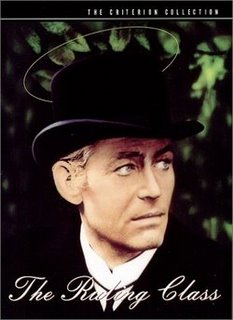
The Ruling Class (1972) review

Could there be a film crazier than Marat/Sade (1966)? Yes, it is the O'Toole/Medak/Barnes collaboration from 1972, 'The Ruling Class.' One could be forgiven in thinking this was a Ken Russell film, but it isn't like he was alone in making blistering-cinema during the late 1960s, early 1970s. We will probably never see an era in movies like this again, it was so free and unfettered by the studio system that it pushed the envelope forever (only to have what is acceptable in commercial cinema recede again). Many viewers would say this kind of film is overindulgent, but that is entirely the point. The Ruling Class was originally given an 'X' rating in the UK in the 154-minute cut, but was released with 20-minutes removed in the American PG-version.
The 2001 Criterion edition is the first time the film has been widely-available in this original cut as it was shown at Cannes. There is no better edition, it is perfect, and a must-own for anyone who loves serious cinema.


The story began as a successful 1968 play by Peter Barnes, and it was considered bizarre for its anti-naturalism, as well as the comments on the English aristocracy. If I describe much of it, the effect will be ruined, but there are musical numbers in a movie that is not a musical (similar to Brecht here). Similar to Artuad's 'theater of cruelty', the approach is to alienate the audience in particular moments--sometimes throughout the entire piece! This was common in the cutting-edge cinema of the time, just watch A Clockwork Orange (1971), Ken Russell's The Devils, or even Midnight Cowboy (1970). Barnes rewrote the screenplay with very few changes, but don't think that the O'Toole/Medak version is simply a filmed play. It is not, it is much more than that.
At once, a parable on the folly of belief systems, it has much to say about the flimsy glue that is the ruling-class anywhere. Some hierarchy is inevitable in this life, but do we want crazy imbeciles running the developed world? And what of psychiatry or academia? Both are beholden to their own class assumptions, as The Ruling Class amply illustrates. Oddly, it is all about the end of all belief, a hallmark of the time it was made in.


The story is pretty strange, yet plausible: the 13th Earl of Gurney (Harry Andrews) has accidentally hung himself in an act of autoerotic asphyxiation, a monologue/prologue scene that lasts over 15-minutes! It's riveting, nonetheless. With the old Earl dead, there is only one heir left for the Lordship of the Gurneys: the Earl's crazy son, Jack (O'Toole). Jack is completely insane, and thinks he is Jesus Christ, messiah and savior of the human race. The would-be Lord is a paranoid-schizophrenic. He is so insane, his speech patterns betray him immediately. He has constant tics, and flights of fancy that defy words, and make this the finest performance by Peter O'Toole in any film (it's his favorite of all of his film performances). 

The performance was nominated for numerous awards in 1972. He really is a sweet character in the first half of the film, and shows some wonderful humanism that is lacking in the rest of his kin. His only conscience is the butler (James Villiers), a closet anarchist! His character recedes as Jack becomes...even more oddly different.
With Jack insane, his uncle Sir Charles (William Mervyn) sets-out to get him declared by a German-psychiatrist he has hand-picked...or has he? It appears that his sister, the Lady Claire Gurney has had an affair with the analyst, and has other-plans for Jack and the whole situation. But Charles has decided he can control Jack through a call-girl he has groomed as the heir's wife, a Grace Shelly (played by the super hot Carolyn Seymour). They are eventually-married by the very reluctant Bishop Lampton (the legendary Alastair Sim!), a distant relative in the Church of England. In such an environment of intrigue, being a paranoid-schizophrenic would be a natural reaction, so one is struck by the fact that being one of the 'ruling class' means to be eventually driven mad. The jokes are biting in this one, with some of the best retorts I have ever heard! To sum it up, the factions are battling for control of the estate through Jack, who is 'J.C.' in the first half of the film. The German psychiatrist finally decides he can cure the would-be Lord with a radical-approach: he finds another madman (the 'High-voltage Messiah', an insane Scot played unforgettably by Nigel Green) who thinks he is God, and puts them in the same room together. It should be noted that Green died after the end of shooting from a barbituate overdose.


This approach of 'two gods in one room' actually has been attempted in psychiatry before, but it usually doesn't work; the delusions are impenetrable. The problem is, the High-voltage Messiah thinks he's the Old Testament God of Wrath and destruction, and it causes a crisis in Jack's version of Jesus, destroying it utterly. You could say that both characters embody the Manichean mythos, and that they hold a heretical view of religion. The High-Voltage Messiah represents the 'demiurge', the blind idiot god of gnosticism, while Jack represents gnostics who believe in the Christ within. Previously, Jack has denied his name as part of his illness and just wanted to be someone else. This is interesting, since early Christians often were given a new name upon entering the cult. Unfortunately, this warmer Christ personality is gone after the treatment, and all that is left is the Old Testament God, and so, Jack takes on the role he was destined to all along. 'I'm Jack, I'm Jack,' says the future Lord, and the psychiatrist and the family think a cure has occurred. 'I'm Jack, alright...Jack the Ripper,' states O'Toole in a moment of hilarity and horror. Instead of the Prince of Peace, he's begun advocating bringing the 'noose back to England', and nobody in the ruling circles notices him as odd anymore. It's really sums up the tone of the film. Most unsettling is the image of the German psychiatrist carrying a cardboard-cutout of the murdered Lady Claire around, yelling 'Cock-a-doodle-doo!'


It becomes clear that Jack is going to be the quintessential 'Lord of Old', a murderer and a punisher, a warlord and an ancient patriarch who kills his children to feed the bloodlust that is at the heart of the will to power. Nobody will be controlling Jack: the butler is off to prison, Charles and the Bishop are off to a nursing home, and the rest had better watch their backs. He dispatches a few of them forthwith. There are a number of scenes that are expressionist: we see some of Jack's hallucinations, such as when he murders Lady Claire in an 1888 Whitechappel-setting, or when he comes to the House of Lords for the first-time--he sees all of his peers as rotted, animated corpses, intercut with what we see. Jack views reality through a poetic lens, nonetheless. 
This latter scene speaks volumes of the undead nature of ruling institutions, and used to be applied to the Catholic Church; it is a Medieval notion. But, it could apply to the aristocracy of Great Britain, which seems to be eternal. It should be noted that the film is a great technical achievement in cinematography and composition. There are also very creative applications of sound elements that aren't related to the images, which are very effective, and are reminiscent of similar techniques in Midnight Cowboy. Bizarre, sexy, unsettling, entertaining, thought-provoking, and classic. The ending? There is no end to this story.