Professor Strowski: Now I am here, to bring you home.
Dr. Erich Vornoff: Home? I have no home. Hunted, despised, living like an animal! The jungle is my home. ...
-Bela Lugosi, from Ed Wood's Bride of the Monster, 1955
The American films (and even a few that weren't) of Edgar G. Ulmer are deeply rooted in the immigrant experience, that irresolvable tug between assimilation and preserving one's identity and traditions. Author Noah Isenberg has illuminated this and many other key elements that combined to create a unique voice in cinema in his biography Edgar G. Ulmer: A Filmmaker at the Margins (University of California Press, 2014) and drawn the best roadmap (with a few detours, pun intended) so far into the many mysteries of that voice. As anyone familiar with biographies knows, things have a way of keeping their secrets. But the author's extraordinary and unprecedented interrogation of Ulmer's vast body of work provides incredible insight and corroboration into his life, and he marshals his information from every conceivable direction in a way that would probably make his subject very proud if not a little bemused.
The essentially itinerant director's professional life began not too many years after becoming a refugee with the internal collapse of the Austro-Hungarian empire in 1916, beginning as it has for many talented emigres fleeing social and political chaos, a process that continues into today. Like so many, Ulmer came to America with great aspirations and a hopefulness that with retrospect now probably seems naive; his first stop was typical for so many immigrants, and where one might think: New York City, during the early 1920s, working on the design of a Max Reinhardt stage production, a first for almost everyone involved. It wasn't long before the young and bright-eyed Austrian had headed to Hollywood, where, like most of America and its many claims to exceptionalism, success is a coldly loaded word. What better, tragic frission could an artist steeped in German Expressionism with its play of light and shadow want? Not a lot of it was going to end on a happy note, and neither do most of films of this underappreciated king of Poverty Row filmmaking who created such classics as the Laemmle era Universal horror The Black Cat (1934), the Poverty row classics such as Blubeard (1944, starring John Carradine), the legendary noir Detour (1945), and the captivating & shimmering noirish moral parable of Ruthless (1948, co-starring the suave and inimitable Ulmer co-conspirator Louis Hayward).
This is all fine and well--but, who was Edgar G. Ulmer, really? It's like asking who Charles Foster Kane, Dr. Mabuse or Jesus of Nazareth was. Luckily, we have more clues on hand, albeit often, as in the rest of life, flawed ones...
Ulmer's a name which crops up constantly in writing on cinema, especially in cult and noir circles, but how many would know of his design and preparatory work for F.W. Murnau on the classic Sunrise (1927) and Tabu (1931)? I had only an inkling, if that, and had only read musings that the filmmaker had worked on a few Expressionist movies, but they were only vague allusions to the fact that he was one of the few keeping Murnau's memory and technique alive in the Hollywood system. He had popped back and forth between Hollywood and Europe as early as 1929 when he co-directed the proto-verite classic People on Sunday (or the German title: Menschen am Sonntag, 1930), along with Robert Siodmak, from a treatment that had been co-written by the great Austrian director Billy Wilder and Fred Zinnemann, all of whom would go on to direct noir classics in America...or at least that's how some of the stories go. Untangling the legends and myths from the facts took Isenberg over a decade; his subject was often the worst source of information, as it were. There are reasons for this that have a lot to do with filmmaking and the kind of people who become motion picture directors: they're storytellers as well as notorious bullshitters, which is often how they get their vision onto the screen in the first place, they lie to achieve it, they're tricksters.
Anyone familiar with Fritz Lang's stories about his own life and career will be recognize Ulmer's propensity to lie about himself and to exaggerate his experiences and accomplishments (including participation in The Cabinet of Dr. Caligari & Metropolis). Lang himself simply made things up to tell a better story; so too did Ulmer, and so many other directors over the years. Not all of this was intentional and shows that for many of them the creative process is never over. This bleed of one's life and work shows so clearly in Ulmer's filmmaking. Additionally, directors are usually intuitive psychologists and master manipulators, again, for aforementioned reasons. It takes a lot of effort to put your signature to a movie effectively and for it to retain your vision and style. Therefore, to do it in less than a week of shooting time, which was typical for Ulmer due to economic restrictions--low budgets--and end up with something somewhat coherent and even memorable is something short of a miracle. Ulmer was able to repeat this miracle many times over. This also means that he produced a lot a bad work out of sheer necessity. Even in those circumstances, he was able to imprint most of his movies with memorable themes and moments that contained not only some of his greatest dreams and aspirations, but those of audiences of his era, and ours.
Long relegated to the margins, Ulmer's body of work has been championed by everyone from the Cahiers du Cinema crowd, the leading theorist-directors of the French New Wave, to contemporary hipster movie buffs, and of course, academia. Isenberg shows us the availability of many of these movies and draws us another path to them, again, with no discernible detours. Thanks in part to the Internet, and like such luminaries in other mediums like H. P. Lovecraft, Ulmer is probably more known and popular today than he was when he was alive. My own Ulmer collection has grown in leaps and bounds as of late and announcements of new restorations of his work have been growing periodically over the last few decades, often to great acclaim.
I first came upon Ulmer's work as the Hollywood cult director of Black Cat (because of its stars Bela Lugois & Boris Karloff and the fact that it was--loosely--"based on Poe"), which is maybe the most unique horror film in the horror canon, never mind Universal's. Isenberg notes ably that the movie went on to inspire The Rocky Horror Picture Show for its own high camp value, which is impossible to debate as the movie revels in its perversity, it's simply true--artistic truth. What first strikes the virginal viewer of Black Cat is the familiar use of Expressionist technique; this of course is obvious, but we shouldn't think this was done by someone who had fled a Hitlerean Europe. Ulmer, as stated earlier, was already installed in the American movie system. A fateful decision of running off with the married wife of a cousin of the Laemmles appears to be the deciding factor that relegated him to Poverty Row, he was blacklisted, even after the regime at Universal changed in 1936 to a man named Rogers after its bankruptcy. Not even hits like Black Cat & The Bride of Frankenstein (1935) could save the Laemmle-run studio from cost overruns during the Great Depression.
Well before the rise of NSDAP & Hitler, talent like Ulmer, Murnau, Joe May (née Mandle, another Austrian), the Hungarian Paul Fejos, Josef von Sternberg (a child of immigrants), even Bela Lugosi, were already working in Hollywood and were "refugees" after Nazi Germany became a reality. They were a different kind of emigre talent, some of whom never quite felt at home in America, or anywhere, and many of them had emerged from the ashes of the Austro-Hungarian empire in the aftermath of WWI. Movies aren't made in a vacuum.
Again: who was Edgar G. Ulmer? We're never going to know entirely, but thanks to studies like this, we can get an idea. Without excessive sentimentality, Noah Isenberg has advanced our knowledge of this great, dark prince of the cinema through a study of his films that delivers to us many answers and many more questions about an often tortured life at the margins. Ulmer has finally come home.
Showing posts with label Film Noir. Show all posts
Showing posts with label Film Noir. Show all posts
Saturday, August 09, 2014
Noah Isenberg's Edgar G. Ulmer: A Filmmaker at the Margins (2014) review


Wednesday, May 09, 2012
DC Madam account: "Why don't you...?"
Ed.--I was recently contacted by one of Jeane's former escorts, a first I might add, since most of them have kept a low-profile for years now. I know all of their names, every single one, because several lists are in my possession from defense materials. That doesn't matter to me. Many of those names came out in the research of the phone records from numerous writers and sites, no one really gives a shit from what I can gather. A French documentary team might be speaking with some of them, but I seriously doubt that they're being that thorough.Also, this being America, there seems to be some confusion/conflation over what a historical account or a chronicle is, and what a book about an event by a non-participant constitutes. Because of the nature of the case, you would have to be God and been everywhere at once to have truly experienced, maybe possible at the NSA, not possible for the rest of us mortals. Hey, not everybody had a course in historiography, so let me make it clearer for those who haven't: the book is an account by someone who was a participant in other areas of the story. At one point there was only Jeane, me, and my co-researcher. After the firing of Montgomery Blair Sibley there was no one for a time, then she proceeded pro se with Preston Burton, her court appointed counsel who came back for seconds (he won out and got to travel to the estate salad bar for limitless trips in the end).Around five days ago I got this comment from the someone claiming to be one of Palfrey's former escorts (see my responses):
Andrea Detty said...I very much hope that your book is not filled with conspiracy theories. I worked for her and was in the trial. I'm so sick of people that know nothing, come to these "of[f] the wall" ideas. I was not the biggest fan of her. The only thing I agree with everyone, is that the trial was a complete waste of time, money, and resources. But if you were writing a book about her and the trial, shouldn't you have contacted people that were actually involved with it?
If any of the former escorts had anything to say to me or to others they would have by now (serious inquiries only). They haven't because most of them are scared shitless from legal harassment. You could write twenty books on this case and never get close to describing it fully. That's how writing about an event goes. Additionally, the public isn't going to sit through thousands of pages. The account contains literally hundreds of pages of primary information from the case. Beyond that, I suppose I need to write about who the attending janitorial staff was during the trial.I repeat: this book isn't like Tom Wolfe where he wasn't a part of the story, where everything was second-hand. There is that--a lot of that--because so much of this case took place in cyberspace, where an information war was fought against the defendant, for starters. Have you noticed that almost everything is mediated these days, indirect, because of the technology? No, of course not, that would be to understand the nature of the historical moment we live in. You know, I'm sorry, it's true, I was unable during the proceedings to go post-human and have my mind encoded on a microchip, then uploaded onto the web, sorry, my mistake there. Put up, or shut up, don't fuck me around. I'm absolutely sure it's going to be the latter. "I would have talked with you, but you got up in my shit"--bullshit, you have no serious intention of setting the record straight, none of you former PMA escorts have but a small handful. I'm very serious, as a heart attack, as the club of a riot cop crashing down on a dissident's skull. No one needs to remind me that I learned the true meaning of "lying whore" from all of this.
"Why don't you blah-blah-blah?" Kiss my ass? Why yes, yes you should.

Tuesday, September 22, 2009
Even more songs from the Site Meter: Democratic counsel Diana Oo again
Site Meter--The enigmatic, the mercurial, the secretive, Diana Oo. If I ever needed to feel like I was inhabiting a Dashiell Hammett novel, what better name for a femme fatale would one need? Palfrey's was a fine, French one, and I once told her she reminded me of Joan Bennett, the femme fatale of them all from Fritz Lang's "Scarlet Street." She didn't care for that, and I can imagine why. Osborne's character dies. At least Jeane had someone to mourn her. It would have been nice had she gotten due process.
| Domain Name | house.gov ? (U.S. Government) | ||||||||||||||||
| IP Address | 143.231.249.# (Information Systems, U.S. House of Representatives) | ||||||||||||||||
| ISP | Information Systems, U.S. House of Representatives | ||||||||||||||||
| Location |
| ||||||||||||||||
| Language | English (U.S.) en-us | ||||||||||||||||
| Operating System | Microsoft WinXP | ||||||||||||||||
| Browser | Firefox Mozilla/5.0 (Windows; U; Windows NT 5.1; en-US; rv:1.9.0.14) Gecko/2009082707 Firefox/3.0.14 | ||||||||||||||||
| Javascript | version 1.5 | ||||||||||||||||
| Monitor |
| ||||||||||||||||
| Time of Visit | Sep 23 2009 2:28:21 am | ||||||||||||||||
| Last Page View | Sep 23 2009 2:28:21 am | ||||||||||||||||
| Visit Length | 0 seconds | ||||||||||||||||
| Page Views | 1 | ||||||||||||||||
| Referring URL | http://www.google.co...BkLI5I-4Pk8XAPNmNV3Q | ||||||||||||||||
| Search Engine | google.com | ||||||||||||||||
| Search Words | diana oo | ||||||||||||||||
| Visit Entry Page | http://chickasawpick...-theyre-looking.html | ||||||||||||||||
| Visit Exit Page | http://chickasawpick...-theyre-looking.html | ||||||||||||||||
| Out Click | | ||||||||||||||||
| Time Zone | UTC-5:00 | ||||||||||||||||
| Visitor's Time | Sep 22 2009 2:28:21 pm | ||||||||||||||||
| Visit Number | 60,347 |

Friday, September 08, 2006
Killer Kondom (1996) review
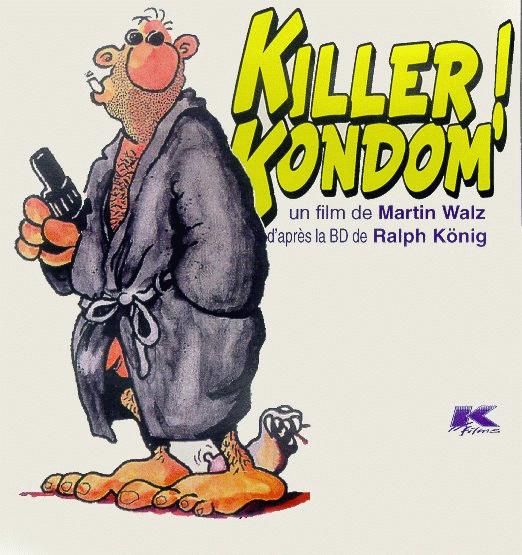
Now here's some REAL German crap! But, at least it's original and entertaining. You've heard it, and probably said it: "Germans aren't funny, they have no sense of humor," but it's untrue.
How do I know this? The existence of this film, silly. The Germans like dry humor, and black humor. "Killer Kondom" is a strange creature that stands outside normal social conventions, never mind movie ones. That's it's a gay comedy is only partly-true, as its criticisms of American and Western sexual proprieties comes from a place that can only be called "pansexual." To call it "seedy" is a high compliment!
Most North American men will feel uneasy watching a film that revels in gay subcultures, but it's also just a great social satire that any open-minded adult will enjoy. We should wish to be scandalized in order to grow, and Killer Kondom delivers the unusual in a film noir and horror vein that explodes into the surreal at almost every turn. Virtually every sexual taboo is explored here, so Killer Kondom isn't exactly a date film, heh-heh-heh, but it's a real hoot.
But, if you want to remove uptight, unwanted company, you could do worse than to pop this into the video-player. You have to admire something this funny, yet so equally annoying. Maybe the funniest thing is that the film takes place in New York City, with an all-German cast speaking their native-language. This alone is going to be pretty funny to North Americans and everyone outside of Germany, but that's before you even get to what can only be described as one of the most absurd plot-lines in movie history!
The story itself is pretty simple: male clients of prostitutes are being castrated by penis-eating creatures in a seedy New York Hotel (amazingly, not the Chelsea!). The protagonist--an openly-gay cop who makes Rainer Fassbinder look handsome--has to discover what the attacks are, who originated them, and why. It's quite a trip to the ending, and often hair-raising, especially if you're male. The depiction of American Midwesterners (anthropologically accurate, yet done in German) is hilarious in the prologue with the hayseed father, and a rare treat that's spot-on in its observations!
Like a lot of European cinema, Killer Kondom isn't always easy to follow, but it doesn't matter, you um...just let it flow. As you might expect, it has a standard noirish voiceover narration that I like for its cynicism, and therefore, it has a familiar existentialist quality to it. Inevitably, the story revolves around its camp/noir/horror/comedy structure, involving a very ugly gay Sicilian cop, lots of subplots of his past-relationships (more Fassbinder here!), and lots of baiting-and-chasing of the mutant condoms.
You could say this film sends up several genres simultaneously, sometimes all in one scene! From the hardboiled, gumshoe Hollywood detective film, to John Waters grossout insanity, to some truly bizarre scenarios nobody ever imagined until the creation of Killer Kondom, this film has it all for those who love trash cinema.
A number of the scenes and makeup were designs by Swiss surrealist, H. R. Giger, although several concepts never made it to the final release print. I've seen his sketches, and they were downright Medieval. Too bad, as his concepts were what made this film worth a look. It could have been better, but one assumes there was no money to realize several of his designs, they were very elaborate.
Troma's DVD is just passable, with lousy audio and picture, but it's cheap and fun, just like a one-night-stand. Killer Kondom is a cult classic with a "Get-the-f%*#-outta-here!!!" ending.
Wednesday, August 16, 2006
Kei Fujiwara's Organ (1996) review
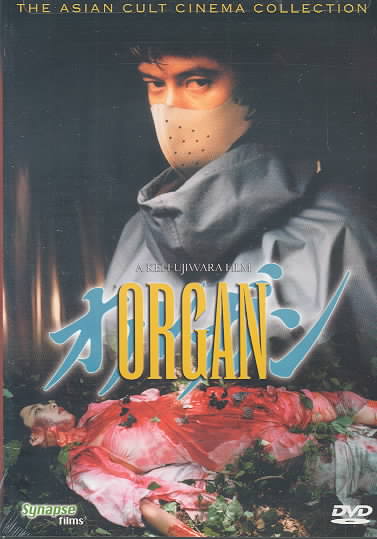
Frankly, I'm astonished at some of the bad reviews of this film--ignore them. If you love extreme cinema that explores the basis of the human animal, you have found a home in the cinematic space-time continuum. Ostensibly, this is a Yakuza and detective film, with elements of film noir and expressionism.
It is not a purely genre film at all, but an art film with incredible complexity about what it is to be human. Fujiwara is best known for her role in Shinya Tsukamoto's "Tetsuo: the Iron Man" (her role is a memorable sex-act), and her relationship to his work shows here. That's because she was co-author of the film, a fact that often gets overlooked. The first Tetsuo film is just as much hers as it is Tsukamoto's. You can still feel her absence in his most recent films.
The human body is the battlefield, as well as the human soul. Much of life to Fujiwara consists-of: birth/mutilation/exploitation/death. Joy is a small-part of this process. To the Buddhist, life is primarily misery that has to be transcended. Maybe it took an inspired woman to say this, and a Buddhist one at that. In so many ways, this feels like a tale by Edgar Allan Poe! The similarities are in the psychological nature, as well as an obsession with repulsion. As a matter of fact, "Organ" is on-par with Poe and his Japanese analog, "Edogawa Rampo" (a pen-name), the other legendary detective and psychological horror writer. This is a film I have watched several times, and it always delivers a new revelation or insight. One viewing is simply not enough to begin to understand it, as in all cinema that aspires to be art.
If Organ is ugly, it's because life has ugliness. If it has beauty (and it does), it is because life does. Even in mutilation, even in our decay, there is a visual beauty. Just ask David Lynch, and just ask a mortician or a coroner. Lividity has an incredible range of colors. Repulsion can be transformed into an attraction to the life-process, it's a philosophical choice. There are roughly two narrative paths to the film: first, the story of the outsider detective searching for his "dead" partner after their uncovering of a horrific black market organ-smuggling ring run by Yakuza, and secondly, the story of the insiders of the ring, a brother and sister. The detective-narrative reminded me strongly of Kurosawa's "Stray Dog" (aka "Nora Inu," 1949), and is probably a conscious nod by Fujiwara.
Other noirish elements reminded me of two films by Yasuzo Masumura: Blind Beast (1969), that has similar themes of destructive sexual-obsession, and Manji (1964). Both films center on a sexual-obsession that intensifies towards death and an ultimate bodily-mutilation. This is why some comparisons of this strain of Japanese cinema with the works of director David Cronenberg are off-the-mark. Fujiwara knows her cinema well.
In the depraved underworld reality of Organ, the surgeon brother has reanimated the "lost" cop and is doing hellish experiments on him, transforming his form into a monstrosity (while paradoxically making him more spiritually human and further dehumanizing himself). Meanwhile, his incestuous sister Yoko runs the organ-snatching gang, and fends-off the outside world, keeping their spiritual sickness and decay alive. It's an interesting structure of hidden worlds and unseen images, which makes the film eminently rewatchable. The philosophical themes of birth-and-death are also very rewarding.
Yes, it's an extremely low-budget film shot on 16mm, but it's also a well-executed work by a genuine maverick of cinema. The rejections of this work come from the gore and the thematic-structure, which must be seen to be believed. Americans have a fear of nearly everything, but especially graphic depictions of death-and-decay and the disintegration of the personality. At the film's philosophical-core is the relationship with the surgeon brother within the organ ring, and the reanimated cop.
As grotesque as the half-dead cop appears, he's more human than the internally-diseased brother and sister. In fact, he's metaphor for the surgeon's remaining-humanity that's slipping-away; Fujiwara makes it clear that the brother and sister were horribly abused as children by their psychopathic mother, making it the origin of their spiritual-decay and sadism. Fujiwara tends towards "nurture" rather than "nature" in this respect regarding the origins of human injustice and sadism. The film, then, is about cycles. As though in some diseased womb, the reanimated cop is hidden away by the surgeon in a secret room where the two have an "internal-dialog" that's a philosophical debate for OUR benefit.
The other half of the narrative is also very powerful. The outsider detective's obsession finding his partner has taken a horrible toll on his family. It seems that being a cop hasn't done himself or his home any good, even before the body snatching incident. These tableaux are just more of the examples of the cycle of abuse and neglect in the film, and they're potent ones. Again and again, Fujiwara paints life as such (so you don't miss it): birth, mutilation/exploitation at the hands of others, and finally, death.
Sadly, this is the fate that awaits many human beings in this inhuman era we inhabit. Consider this when you buy products "Made in China" sometime. Out of the themes of this film, one could surmise that Mrs. Fujiwara has a strong ambivalence to motherhood. What is puzzling is why so many women do not. This film is a contemporary masterpiece, hands-down. "Organ 2" [Ed., 08.30.2008--Called "Id," also extraordinary.] has been completed, so expect more of the same!
Subscribe to:
Posts (Atom)