A review of the director's cut is coming in a few days.
Showing posts with label Cinema. Show all posts
Showing posts with label Cinema. Show all posts
Saturday, October 18, 2014


Thursday, October 09, 2014
Clive Barker's Nightbreed Director's cut
I was one of the first thousand to preorder it. I saw the movie back in 1990 and wasn't entirely pleased with it. Warners billed it as something like a slasher at the time, which is not. What Nightbreed was and now is again is the Citizen Kane of monster movies where the tables are turned--or that's what it was supposed to be, an epic tale, a metaphor for discrimination against LGBT people, and much more, a lost classic now found and restored to its former glory before the suits got their hands on it.Postscript, 10.10.14: It's arrived! This is going to take some time to digest, but I should have my first observations up in about a week. The set is pretty amazing and the new artwork for the 3-BD set is better than the promotional art at the time. David Cronenberg should be pleased, he gets more screen time.
A comparison is in order here: This is like the achievement of a full restoration of the first gay-positive movie ever made, Different from the Others (Anders als die Andern, 1919, starring Conrad Veidt, the somnambulist from The Cabinet of Dr. Caligari) or The Magnificent Ambersons (1942), it is historic.
I should receive the set by this weekend or early next week. A sprawling review and reflection on the new cut is coming. I'll also be doing a similar essay on Breaking Bad as a cultural and historical phenomenon in time now that the series has concluded and the dust has settled a bit. Expect the unexpected.
10.11.14: After watching the director's cut last night, I can say that we have a new classic. What's most surprising is how what Barker intended most is a great, epic love story, a tale of universal love. Nightbreed has finally arrived to the audience it was intended for all along. There are so many things to say about it, and I will shortly.
Audio and video quality are superb--it looks & sounds vastly better than its theatrical debut which is saying something. Yes, David Cronenberg has more screen time. I won't be printing any spoilers.
Monday, April 01, 2013
A reflection on Metropolis
Fritz Lang was a Futurist by default, as was his wife, Thea von Harbou, and by default, fascists, but Lang "rehabilitated" himself in the end, while Von Harbou died of shame like a lot of Germans in the aftermath of WWII...
Friday, August 21, 2009
Inglourious Basterds (2009) review
Where in the world does one begin with Mr. Tarantino's new opus? Let me say first, that he's got a winner on his hands here, hands-down, and that Inglourious Basterds is going to woo even the hardest hearted Tarantino hater, it's that good, that funny.
In 1983, I had the pleasure to see the original "Inglorious Bastards" (1978), directed by the great Italian action director, Enzo Castellari on cable television. It became a kind of legendary movie for me and my friends over the years, and like Tarantino and his crew, we used the short-hand of "Inglorious" when were referred to it. The reason it became a kind of legend to us has a lot to do with the availability of movies almost thirty years ago: there was literally no other way to see this film over the years, and occasionally, I would see an article or a blurb about it, even meeting others who had seen it, but no dice, it eluded me on home video for over two decades.
Finally, belatedly, the word was out that Tarantino was directing his "homage" to the movie and many other war films and the original was re-released onto DVD in 2008 by Severin-Films. How times change. Now you can find the most obscure movies ever lensed, and easily, even cheaply. I assume Tarantino somehow saw the original "Inglorious" either the same way (TV), or through his job with Roger Avary (now in deep doo-doo over...you don't even want to know) at that legendary video store he was once a mouthy but knowledgeable clerk at. It must have been one hell of a well-stocked video store, that's all I'm saying. The critics are already weighing-in that this is a tale of revenge, and it is, but that's if you take the surface-level of the film with the utmost seriousness which is losing the entire point with his movies. Yes, Tarantino goes to incredible pains to create a convincing cinematic reality, and yes, this is based on Castellari's original tale in some very basic areas (like the title, and the fact that it takes place in occupied France during WWII), but that's about where it ends; this is about movie reality and the homage once again. You either like the director's writing and directing style, or you don't, and I'm with the former.
Recall that Castellari's original 1970s "rip-off" of The Dirty Dozen (1968) is really more an homage to Peckinpah's The Wild Bunch (1969), a story about another group of scoundrels that you end up at least respecting by the end of the film because they do something good to redeem themselves. To cut it short, Inglourious Basterds isn't even a revenge film or a revenge fantasy at all as some critics have written. It's more and less than that because it's not really about WWII directly but about the cinema before, during, and after the war, the cinema surrounding the rise of National Socialism and its demise, and the movies made about it after-the-fact. Once again, this is a movie about movies, so just enjoy the ride.
If you really wanted to reduce a good part of the movie itself to its fundamentals, you could equate it with someone talking about WWII cinema and the nature of the movie business in the 20th century, which when referring to Hollywood means that the subject of Jews in the business is inevitably going to come up (and not necessarily in a negative-light). It's not a political film, but it does have some interesting political implications to it; one way of describing it is that it's WWII through the movies, even being "won" by the end through cinema, film itself, quite literally, as part of the plotline. Fortunately, that's not giving away too much. As with most Tarantino movies, we get the famous chaptering. The very first scene is very reminiscent of the style of Sergio Leone and many parts of the film could be compared to a Spaghetti Western with faces serving as landscapes, and landscapes serving as faces; and as you might expect, many of the characters are "stock" ones grabbed from other WWII films. There are even occasional nods to the great war movies of Sam Fuller.
But then, we get a lot of references to the cinema of the 1930s--mostly German and French, a little American--like the references to Leni Riefenstahl, who as a Teutonic heartthrob of their "mountain films" wowed German audiences and had a certain sex appeal among the Nazi cadre. Riefenstahl had other talents that would flourish under National Socialism. She later went on to direct the most well known Nazi propaganda film, "Triumph of the Will" (1935) and "Olympiad" (1937). But then, we also hear about G.W. Pabst ("Pandora's Box" with the sultry Louise Brooks), and even Henri-Georges Clouzot's "Le Corbeau" (1943). This is all going to be over the heads of most moviegoers when they go to see Tarantino's new work, but it adds to the experience and cinematic richness nonetheless.
And then there is the violence: it's not nearly as graphic as many reviewers are painting it, and it's not present in much of the film. I'm sure some Jewish members of any given audience watching this movie might view it as a revenge story of some sort, and to some extent it is, but so is Death Wish with Charles Bronson. Everything is a prop in Inglourious Basterds, used by Tarantino to drape his dialog and vignettes on. I think that's about as deep as Tarantino wanted to get into that aspect of his tale, a story that could be seen as autobiographical in some strange way. There's not much that I can say that's bad here; from the production design that's right out of Tinto Brass's "Salon Kitty" (1976), to the musical-stings by Ennio Morricone copped from several Italian classics of the 1970s, and even to the use of David Bowie's "Putting Out Fire With Gasoline," this is about style, and little else. There's nothing wrong with that.
There is gore (a couple scalping scenes are probably referencing William Lustig's "Maniac," not even a war movie), there is violence, and you could be forgiven for thinking that Tarantino decided to place Pulp Fiction and Reservoir Dogs in the midst of WWII, but it's all very deadpan, very funny material. The comic timing itself is pretty impressive and the dialog is up to the writer's normal standards. Perhaps what's most impressive is that Quentin Tarantino has forced American audiences to sit through a roughly 3 hour motion picture where 3/4's of it is subtitled, no mean feat. I predict a hit here. There is no real political message to Inglourious Basterds anymore than there was in a lot of the WWII genre, and if there was, it was unintentional and purely a product of the times they were made in. With the ousting of an "ugly American" president in George W. Bush, there is at least for this brief moment that one thematic-thread that runs through most of the postwar WWII genre: the mutual-ties between the former allies and their cultures, their people. Even Star Wars reads like a retelling of WWII, but Inglourious Basterds could read like a retelling of the movie industry after it. So far, Europe has been "liberated," conquered at Cannes.
In a telling scene with comedian Michael Myers and a character actor playing Winston Churchill, the British high command wants a briefing on German cinema under the Nazis from one of their officers. The look is right out of the films of Michael Powell and even Lindsay Anderson. The Myers character brings-up the fact that "Goebbels has gotten the Jews under control" in their motion picture industry. Churchill chimes-in: "We need to find-out how they did it." An enigmatic statement if ever there was one, but a funny one; Inglourious Bastereds is a knuckleheaded flick for cineastes, a must see, and almost as funny as 1984's "Top Secret."
Friday, September 12, 2008
"Fellow critic hits [Roger] Ebert during film festival"
Toronto, Canada--Hey...I thought Gene Siskel was dead! It was dark, nobody could see exactly what was going on, then this guy who looked liked Lon Chaney came in and bum-rushed porky, and--POOF! He was gone.
What's going on here?! Fuck me! What's next? People yelling "Ewige blumenkraft!" in the streets of Toronto again, Jesus. And we all know that they'll be congregating in Kensington market, yeah. Game over man, we're not putting her in-charge, eh!
Siskel once called for the banning of director William Lustig's "Maniac" (1980), which was a no-no for a critic. He and Ebert frequently came very close to fistfights during their PBS program that nobody remembers anymore. And now, dear God in heaven, something has come back for revenge in the streets and theaters of Toronto. No, not the hookers. Something worse...
There is a shadow descending on Ontario, and it's a congenial spirit, eh. You should visit it sometime, really. The Chinese food in London is O-Kee, but the peeps run drinking games when they watch "House" ("Hoose"). But somebody had to make Ebert pay (again) for slamming "Brown Bunny." Get real, it was Vincent Gallo, and I applaud him, great film.
Saturday, September 01, 2007
Rob Zombie's Halloween (2007) review

In 1978, I tried to see the original John Carpenter film, but I was only ten-years-old. Interestingly, the local theater played it again in 1980, as the word-of-mouth on the film had spread and it had become a major independent hit.
For a long time it was the most successful independent film ever made, though the lousy Blair Witch Project ended that record. What can I write about the original that hasn't already been written? It's incredible, and very atmospheric, a favorite, and still pretty plausible and creepy. It could happen. The same could be said for the new version.
Rob Zombie has given genuine horror fans a wonderful gift: we don't have to feel bad about missing the original when it came out anymore. This is equally good and pays incredible respect to the original, and Zombie discussed the project and his take on it with John Carpenter beforehand, something that wasn't done with the so-so 'Dawn of the Dead' remake.
Shot in the same widescreen Panavision (2.35:1), we get a familiar story with some significant changes: gone is the possible supernatural quality of Michael Myers, a phantasm who becomes something non-human, a part of the holiday itself. He's just 'the shape' emerging fully-formed in the 1978 version. In Zombie's recasting of the original screenplay by John Carpenter and Debra Hill (RIP), the focus isn't on the mystery surrounding the killer, but offers some explanations as to why he is what he is.
This version makes the killer and his victims human, and this is where a number of so-called horror fans are going to be split. To make his point clear, the director begins the film before the prologue killings of the original, and paints a more contemporary and honest view of American family life, while setting it as a period piece in the late-1970s (the time of the original film's release).
It's a very vivid recreation of the decade that was my childhood, and it has an aspect of social realism to it, regardless of the stylization of the film itself. It's an awfully realistic depiction of squalid American working-class family life during that era, which I bore witness to in other families around my neighborhood. These are the people nobody cares about. Little has changed, as the movie makes clear, and the seeds are now bearing their fruit.
Rather than the brief glimpses of a straight-laced 1963 Myers family, we see a disaster of sexual, emotional, and physical abuse. This wouldn't have been possible in 1978 to the degree it's depicted by Zombie and his collaborators (if you wanted an 'R-rating' then), and actor William Forsythe (Patty Hearst, Dick Tracy, The Devil's Rejects, and much more) does a fine job playing an abusive step-father to Sheri Moon's stripper mother. It's not a healthy home environment.
What I found mind-blowing, however, was just how well Rob Zombie remembers the cultural landscape of late-1970s America, it was jaw-dropping. From the expletive-laden, sexually humiliating slang of the kids bullying young Michael in a school bathroom, to the music, the kitsch (t-shirts and joke-stickers abound), and the attitudes, he's brought the 1970s to gasping, breathing life again. It's an incredible time-capsule, and it made for what is a great way to adapt the story to a contemporary culture and setting: NOW.
As one would expect, there is a lot of movie history and homage to be found in this film, and it's a real joy, but the director decided to take-up the aesthetic of Kubrick and Peckinpah in his depictions of violence and murder. What's that you say? Read on.
If you've ever watched a Sam Peckinpah film, you already know what I mean. If you've ever watched--truly watched--Stanley Kubrick's "A Clockwork Orange" (1971-72--cut and re-released due to an early 'X-rating'), you understand what an anti-violence movie must do in order to get its message across: it has to show mayhem for what it is, which is drawn-out, ugly, and something that has consequences for the perpetrators and society. You're not supposed to get-off on the violence, you're supposed to be repulsed and fearful of it.
Insofar as violence and murder are concerned, it's well-established that once the door has been opened, it's rare that it ever gets shut until all the players are dead or neutralized in some fashion. Will gore hounds love Zombie's 'Halloween'? Yes and no. They'll enjoy the brutality and grimness--there's plenty of that on-offer here--but they're not going to find the violence entirely enjoyable or even tolerable...that is, if they're normal.
From "The Wild Bunch" (1969), to "Straw Dogs" (1971), and even to "Bring Me the Head of Alfredo Garcia" (1974) and his final film, "The Osterman Weekend" (1983), Sam Peckinpah wanted to show us that violence has consequences and that it is something ugly and to be feared. His message was cautionary, and that same message is apparent in Rob Zombie's take on Halloween. It's not meant to replace the original at all, but to compliment it.
The story-jump of fifteen-to-twenty-years is covered more here--the time that Michael Myers is locked-away in the mental institution, and his time with Dr. Sam Loomis. As most fans of the original remember, it was the late Donald Pleasance who played this part, and exceptionally well. Cult legend Malcolm MacDowell lends the same authority to the role, we well as cementing the anti-violence message of the film by his mere presence, and his performance is of a more caring Loomis. He pities Michael Myers, and in a nice touch, his relationship with the killer is extended back further as a school counselor.
As in the last two Rob Zombie movies, we get a gaggle of b-movie legends: the great Ken Foree (1978's Dawn of the Dead, From Beyond, and much more), the incredible Bill Moseley (Texas Chainsaw Massacre 2, House of 1,000 Corpses, etc.), Joe Pilato (The Matrix, and almost everything else), the great Udo Kier (Andy Warhol's Dracula, Shadow of the Vampire), Brad Dourif (Blue Velvet, One Flew Over the Cuckoo's Nest, Dune), Clint Howard (everything), Danny Trejo (Grindhouse, Maniac Cop 2, Whore, From Dusk Till Dawn, etc.), Richard Lynch (God Told Me To, The Sword & the Sorcerer, Deathsport, Vampire, and more), and several others who will please most movie buffs.
But what I found really smart was casting the Laurie Strode character (originally played by Jamie Lee Curtis) with someone with a low-profile as an actress--Scout Taylor-Compton. Little Daeg Faerch as '10-year-old Michael Myers' is the real eye opener here, and he makes the movie very unsettling. Imagine watching a child descend into insanity--I cannot think of anything more disturbing, but that's what Zombie depicts. It's like a slice of Poe, it's the essence of horror. We get to see the process unfold, even after the initial murders, and it's not exactly entertaining. It's truly horrifying to watch a little boy transform into a killer.
Very few films--to my knowledge--have ever depicted a child murdering another child in a drawn-out fashion (think Hitchcock's "Topaz"). The Loomis character adds to the 'whys' of how Michael Myers became a murderer--that he was a 'perfect storm' of 'internal and external influences,' someone with pre-existing tendencies who was pushed too-far by his environment. It might have went in another direction in another home, another community...another life. But it didn't. Rob Zombie's Halloween, then, can only be a classic tragedy that is almost mythic in its examinations of violence and the family.
Wisely utilizing an original score with the original Carpenter themes (albeit adapted) and a bulk of new musical-cues , as well as that same William Shatner Halloween mask, Zombie has scored a classic study in what makes a serial killer while retaining what made the original so good. One could find comparisons to Richard Speck or even Henry Lee Lucas and Ted Bundy. The parallels are there for the curious to examine. A must-see for those concerned about the roots of violence, and a solid addition to the canon of horror. Evil has a destiny alright--constructing its own demise. Rob Zombie has nothing to prove after this film, good job.
Wednesday, October 04, 2006
The Rise of Anthony Hopkins: Magic (1978) review
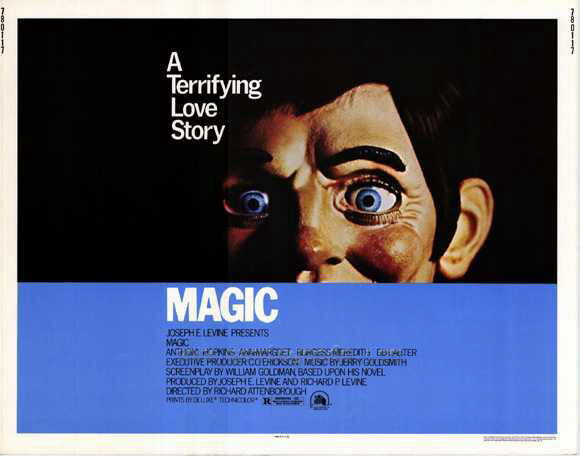
"Abracadabra, I sit on his knee. Presto, change-o, and now he's me! Hocus Pocus, we take her to bed. Magic is fun...we're dead." --The tagline to Magic
Schizophrenia is still a very controversial mental-illness, and many psychiatrists have argued over the years that it doesn't even exist. But what we do know is that the mind can fragment into quasi-independent parts that can behave like personalities, or aspects of personalities. At any rate, the neuropathology of schizophrenia is unknown and has only been studied for some 100 years! Right now, the science tends toward heredity being a primary-cause, but there is no total consensus.
Enter the movies: While psychological horror is nothing-new to cinema, this 1978 film by Sir Richard Attenborough (A Bridge Too Far, Gandhi) is very-very special, and offers some interesting speculations. Originally a best-selling novel by William Goldman (who also wrote the screenplay), this is also the 'big-break' of Anthony Hopkins. It was the moment the public really took-note of this 40-year-old actor. Other than The Bounty (1984) this has to be his best film-performance, where he even had to learn to articulate a ventriloquist's dummy and throw his voice.
Hopkins plays Corky, an amateur magician who is too shy to charm an audience where he bombs at his first performance in the film's opening prologue, subbing for his dying mentor, "Merlin." Corky had become enraged and scolded the bored crowd and had a kind of a mental breakdown. Cut to two-years-later, and Corky is selling-out the same nightclub with a residency and lines around the block. There's been a strange transformation in the entertainer, and he's gained some kind of an edge.
Something happened over those two years and Corky's addition of a foul-mouthed ventriloquist's dummy named "Fats" has made his act wildly popular: he's funny and profane, spouting dirty-jokes and insults at his audience. Fats acts and looks like a distorted version of Corky, maybe even his shadow self, a nice touch of the Jungian in the screenplay. But, was it "Fats" who chewed-out the audience two years ago, or was it Corky? Or was it some supernatural force, a dead soul raging against the living? As in life, there are no easy answers in the late Sir Richard Attenborough's version of Magic. Screenwriter Goldman and director Attenborough let us decide for ourselves, and it's this enigmatic style that makes Magic so interesting and incredibly chilling. Jerry Goldsmith's eerie score doesn't hurt either, it's reminiscent of Bernard Hermann. This is a small story with epic dimensions, the landscape of the human mind, the human soul. Magic is classic tragedy.
Sure, we know that Fats isn't really alive and that he's just an extension of Corky's tortured psyche, but there are a few moments where he literally moves without help, shot objectively! It is as if the disease has externalized itself, taking over the protagonist and even the narrative. The effect is especially eerie. There is a light-touch of ambivalence as to whether Fats is more than just a part of Corky's psychosis, but this is soon upended by several objective-views of his behaviors without Fats; but Attenborough keeps things ambivalent nonetheless, and all the way to the finale. Fats only moves a few-times without Corky, and sometimes Corky sounds like Fats when he gets angry. One almost gets a disembodied-sense watching this, a little taste of madness. And so, with his fame comes a fear of exposure of his illness. His show-business agent wants him to take a physical for a network television-appearance, and Corky refuses, escaping to his hometown in the Catskills.
He seems to know instinctively that he is mentally-ill and Fats the dummy even reminds him that, "We're special." Indeed "they" are, they are abnormal since it should be impossible for there to be more than one of them. A schizophrenic fear of persecution becomes obvious in the protagonist over time. Fats wants to return to Manhattan to fame-and-fortune but Corky doesn't, he wants to hide. The pressure builds as the two personalities fight, and Fats becomes jealous of a childhood love named Peggy, played by the legendary Ann Margaret. She runs the cabin Corky and Fats are hiding-out in, hiding from the world. Corky's relationship with Peggy can only be doomed from the start, and one gets the impression that because of his illness he's never truly grown-up and that he's incapable of an adult relationship with anyone.
There is something so creepy about Fats, and it isn't hard to believe that he comes from somewhere deep and unknown within the human mind, a kind of atavistic force that might have been useful once for the purposes of survival; at one time, we may have had to be many people. Therefore, Fats is a force rather than a personality, and he is virtually rage and vengeance personified. Corky repeats his fears of failure to Peggy in a mind-reading session with playing-cards, and it is here that it seems Corky isn't playing with a full-deck (sorry, I had to write it). Is it a case of MPD (Multiple-personality disorder)? Is Fats a primeval darkness within Corky, brought-on by his illness and magnified? It seems to be a complex combination of many things, and the descent-into-madness of such a likable character is very unsettling and saddening in a way that only insanity is capable of being. Though it's best to remember that this is a movie version of mental-illness, it works, and has a very powerful artistic truth to it, therefore an objective truth. Corky is basically a paranoid-schizophrenic with some writing-touches.
Perhaps Magic's best scene is when Corky's agent (played with subdued class by the late, great Burgess Meridith) finds him at his hideaway and challenges him about his sanity: "Corky, can you make Fats shut up for five minutes?" Corky can't do it, and the scene is hilarious, heart-breaking, and horrific. Eventually, Corky kills a couple people in a feeble attempt to hide his illness and it all just snowballs. Exposure is inevitable, and I leave the ending for you to watch yourselves. Magic is a film that is both funny and sadly poetic, portraying the dying of a beautiful, prismatic-mind that had so much to give but couldn't. This makes Corky the classic misunderstood "monster," and Magic, a horror film. He simply cannot help himself.
Mental-illness in the universe of Magic is tragedy--as it should generally be viewed as--and our connection with Corky is almost like that of an accomplice, just as with Norman Bates in "Psycho" (1960) when we guiltily worry he's going to be discovered. We want him to keep hidden as a part of natural empathy. Magic is that wild ride that is both humanizing and sad, but also very entertaining, even a criticism of the entertainment world itself, not a very healthy place to be in most ways. After all, once Corky is sick, the crowd loves him. The more he openly reviles and despises him, the more they love him and his little friend. Fats, then, really is an externalization of his illness, and it all seems like a diseased version of the American Dream, a disease of another kind.
While the majority of schizophrenics aren't violent as in this classic movie portrayal of insanity, this could certainly happen, and that's why I find it so horrifying. People lose their minds, and they lose control to impulses that we and they do not understand entirely. This is the terrible horror behind Magic, it's black heart. Hopkins did the eerie voice of Fats, even throwing-his-voice, and he gave the dummy an old vaudeville/freak show barker quality. To these ears, he sounds like a street hood from 1920s New York City, like a completely other personality than Corky's. Fats sounds like someone who lived once in another body, rather than some strange voice from the depths of a tortured man's soul.
The twist-ending seems to support this possibility. So, one would imagine from Anthony Hopkins' performance that he was at least nominated for a major award. But, this was an independent film by Attenborough and producer Joseph E. Levine, so an Academy Award™ was out. It's ironic that so many films that win Academy Awards™ any-given-year are often forgotten, but ones like Magic are remembered fondly. As anyone knows, Magic is timeless.
Subscribe to:
Posts (Atom)