Even in the earliest reports, we've been seeing that the Tsarnaev family was dysfunctional. Zubeidat Tsarnaev, the mother of the bombing suspects, was busted for shoplifting at a Lord & Taylor fashion shop. Now we're finding out that she was on the same terror watch list as her oldest son.
Another of their store locations was on Boston's Bolyton Street, where the bombings took place, and where video captures of her two sons were taken moments before and after the blast. With the evidence is mounting against the deceased suspect Tamerlan Tsarnaev and his younger brother Dzokhar, and with some arrows pointing at the mother, investigators in Dagestan speaking with associates of hers, I wouldn't be too surprised if she was arrested soon.
We might just find out that there was no sound ideological or religious justification (you think?) behind the bombing at all. What it could have been was retribution directed at Lord & Taylor and Boston in general for charging their mother with shoplifting. If she was guilty, and they were of what they're alleged to have done, what you have is nothing more than a pack of criminals and nothing close to terrorists. All of Zubeidat's crazy conspiracy theories about what might have occurred conveniently point away from her sons in the face of almost irrefutable physical and photographic evidence, as well as eyewitness testimony from the carjacking victim they kidnapped and confessed to. Her theories, by obvious implication, then, point away from her.
The uncle on the father's side of the family might know a lot more about this woman than he's stated so far, and what they were capable of, what he might have thought they were headed towards. But who could predict something so crazy? I'm also betting that the enigmatic "Misha" is more of a red-herring thrown out there by the parents.
This has nothing to do with Islam.
Showing posts with label Mental Illness. Show all posts
Showing posts with label Mental Illness. Show all posts
Saturday, April 27, 2013
Was the Boston Marathon Bombing Done Over a Sleight?


Tuesday, September 01, 2009
The New Devil's Dictionary: Delusion

Delusion, n.--A shared belief supported by power, therefore true. When the belief is not shared by the group, untrue, and therefore, the holder of it is mentally ill and resistant to reasoned argument or objective proof.
When the holder of said belief is not strong enough to enforce it on the group the belief itself is untrue, and therefore, they are heretical or mentally ill; also designates the pathology at the core of all civilizations.
Examples include the core belief of Aztec civilization that violent imperialism and the capture and sacrifice of enemy warriors was necessary in order to prevent the universe from plunging into eternal darkness. Incan civilization held that expansionist measures were necessary to please the gods and feed the cults of the dead emperors. Roman civilization felt it necessary to spread "Pax Romana" (Roman peace) to the barbarians, and so on.
Current examples posit that the core belief in the profit motive will continue to provide sustainable prosperity ad infinitum and redeem the world, while another related core belief of contemporary human civilization posits the "need" for entrenched and unaccountable hierarchy in order that the species may continue into the future. (also see "Identity politics" and "Pathology")
Saturday, August 01, 2009
Are some serial killers created? An observation, by Len Howlett
I had been to North Miami Beach High (no, but I was sure spaced out by the time I graduated --an old throwaway punchline from Rowan and Martin's "Laugh In") to a seminar on teaching A.P. Chemistry, and there was a lunch break with a convenient little neighborhood deli across the street.
I went into the place and had a seat at a table in the small, almost full dining area which may have had a dozen tables in it. A guy I recognized from the seminar came up to my table and asked if I would mind if he sat in the chair across from mine. I invited him to join me. He was a personable guy and told me that he was from Queens or Brooklyn, or whatever borough it turned out that Dave Berkowitz lived in during his adolescence. The talk was light, and I was a curious figure to him since I was possibly one of the few people that he ever met with a Southern accent who loved Manhattan.
So, the talk went on, and it ranged from topical stuff to teaching and its pros-and-cons. I observed that maybe the best or worst of our tendencies embodied the vast potential that inadvertently plays a part in shaping future lives, which in the end, was more important and long lasting than anything they could possibly retain of the facts of Chemistry.
"After all," I said, "we could influence their view of the academic and the adult world just through example, either for the better or the worse. Then I made a statement--mostly in-jest-- that I didn't want to feel like I had helped make any serial killers or engendered resentment that twisted young psyches. Looking back, I can only believe now that I must have been reacting to some recent news about a case that was still active, and I was regarding my corned beef and half-a-sour pickle when I felt the stillness of a significant pause and a rather sobering, quiet response from him.
"I may have," he said. I looked up to catch the light humor I would expect to see in a satirical reply. It wasn't there. He was somber, like someone who feels the gravity of an act gone bad and the silent record of guilt.
He added, "Not as a teacher, but as a student."
"How so?" I asked.
There was another significant silent space and a measured response. Then he said he went to the same high school that David Berkowitz did and asked if I remembered who that was. "Of course, I did," I replied. He had been in the same class as Berkowitz.
I asked what kind of kid David was: his reply was the expected description of a friendless, lonely boy who ate every meal alone, sitting in the cafeteria at a table by himself. My lunch companion said with detectable guilt that he had been one of a group of four boys who would sit the next table over and ridicule and harass him every day while David sat and wordlessly ate his lunch.
The topic he remembered most frequently was the question, "So what you got planned, Dave? You got a hot date? I hear all the girls taking about you? They really like you. They're crazy about you, Dave." You know, the usual compassion of high schoolers and humanity when it's allowed to distract attention from it's own loneliness and self-doubt.
Then he said, "So, I come home one day some years later and open the paper and who do I see on the front page being led away by the police wearing that frightened smirk that I had watched him walk around with for years in high school?" He said he recognized Berkowitz immediately, even before he read his name, even though he hadn't thought about him in some years. And then, he said that he often found himself wondering--if just maybe--he had played a part in what happened later. "Maybe, maybe not," was all that I could say.
But nowadays, I think about it and the unknown consequences of unthinking actions.
Sunday, March 15, 2009
The Horror: E!'s "Hot Girls in Scary Places" and the "Ohmigod" factor
tv--I don't know whether this show is the worst/best thing on television now, or if it's just total crap. Are they kidding? Surely, they are, but don't be so sure. That "reality tv" has that same revolting-yet-hypnotizing quality that infomercials once--once?!--had is one of its hallmark features.
I've had the misfortune to (un)watch several of these so-called paranormal investigator programs, and like most people over the age of 13, I think it's all faked, played-up, and basically a bunch of aspiring actors doing a very bad job at appearing to believe it's all real. That's called "acting," by-the-way.
The premise is exactly what you would think: a bunch of vacuous models are taken to some "haunted" building for the night where lots of people were alleged to have died violently, or whatever. Yeah, whatever is right. OK, so it's just a pilot, so let's hope it dies the death that "Survivor" should have nine years ago. Give them a head full of acid, I say, then those gals will believe the place is haunted. Viewers might try the same, but I don't advocate the use of psychedelics.
But I should really be fair here...and brutally crucify the creators of the show. A brief explication of "Hot Girls in Scary Places" is in order:
The show stars three University of Southern California cheer squad friends challenged to spend the night in a supposedly haunted abandoned hospital for a cash prize of $10,000 (which would pay for maybe half a semester at USC). To get the prize, the trio will have to complete a series of challenges.
“They’re totally scared, and totally believe experiences they’re going through,” says executive producer Gary Auerbach [Ed.--He has a Facebook account!]. “They’ll get scared and then be talking about a sorority party coming up. It’s a little bit 'Scooby Doo'-ish.” ("E! orders 'Hot Girls in Scary Places,' " The Live Feed, 02.12.2009)
So it's definitely "ish," at least. Today, I got to see some of the rerun from Friday night (the 13th! Eeek!), and I have to at least say that the sensations experienced were both unique and alien. That doesn't mean they were good.
OK--they're all in a hospital, they don't seem scared at all, and nobody got laid--at least on-camera. The majority of what I witnessed--and it was all blood-chilling, just not the way you might think--was a gaggle of very bored coeds giggling and jiggling, a faked series of EVP (electro-voice phenomena, allegedly recordings of "spirit voices"), and not a hell of lot more. In reality, it looked like dumb outtakes from Jackass. Yet, we Americans love having things lying around that we don't need, so I assume the show will get picked-up as a series, mainly for its obvious camp value.
Where's Fred and his gay-sash in all of this? Will they have the old guy at the end exclaiming, "And I would have gotten away with it if it wasn't for you doggone bimbos." Perhaps, perhaps not, we'll see. My bets are on the old codgers. Some news outlets are saying that this show is a conscious "send-up," but do we really believe this? Perhaps, but why not make a drinking game out of it anyway, for every time one of the girls says "duhhhhh," "like," and "Ohmigod!" Yes, the dreaded "Ohmigod!" factor.
Executive producer Gary Auerbach has produced at least a dozen of these kinds of moronic reality shows, but his shows that bear the most obvious relationship to "Girls" is "Paranormal State" and "Lost Tapes," both-of-which are equally boring and impossible to accept or believe as anything but staged boredom. Even the "participants" and "investigators" appeared bored and incredulous. Well, right, because there is no supernatural anything and nothing after this life and no Easter Bunny or Santa Claus. Sorry.
Auerbach also produced "Punk'd" and several other MTV shows that are boring, so "Girls" was no real surprise here. But really, it is a soul-sucking and Satanic thing, this show. Just the mere existence of a show with a title like "Hot Girls in Scary Places" is enough to cause the dead to rise from their graves and seek revenge...on the barely-living, the barely-conscious, and that's not even dragging the viewers into it (that would be the show's backers). Did I mention he directed the early-1990s "Jon Stewart Show"?
Hey, everyone has to start somewhere, and I don't blame the producer for the state of the entertainment business. No, somehow, I can't blame Auerbach entirely. That blames rests with the money people in the entertainment industry who want to jettison troublesome union actors, crew, and writers, so that they can make lots of money and...crap. If they really want to entertain us, why not airdrop a pile of these social darwinists in Darfur, Afghanistan, the tribal regions of Pakistan, or over the borders into Iran? Or why not just let set "Girls" in the bad-parts of Oakland or Watts?
Best yet: airdrop these entertainment backers into the aforementioned places along with the rest of the CEOs of America. That would hardly be a boring show, that.
"E! orders 'Hot Girls in Scary Places,' " The Live Feed, 02.12.2009: http://www.thrfeed.com/2009/02/e-orders-hot-girls-in-scary-places.html
Friday, January 04, 2008
West Memphis 3 Update: Terry Wayne Hobbs vs. John Mark Byers?
West Memphis, Arkansas--In a case that has had as many twists-and-turns as the aftermath of WWII, there is another bizarre development: John Mark Byers is alleged to have come out for the innocence of the West Memphis 3. At this time, it's impossible to corroborate as Byers is alleged to be claiming that he's been doing "undercover work" towards whether another step-father might have been involved in the murders of the three eight-year-olds back in 1993--Terry Wayne Hobbs.
[John] Mark Byers has recently come out in favor of the innocence of those in prison. He has said he has helped perform undercover work, making tapes of his conversations with Terry Hobbs. He has made some remarkable allegations about Hobbs past. The supporting evidence for these allegations have yet to appear. (http://www.jivepuppi.com/Terry_Hobbs.html, November 15th, 2007)What's interesting is that there have been suspicions that Byers did in fact do "undercover" informant work for the West Memphis Police Department prior to the murders of his own step-son and the other two children. It's likely that the informant work was related to drug interdiction, as West Memphis is a well known corridor for the flow of illegal drugs through that part of Arkansas. It should be noted that Hobbs's and Byers' step-sons suffered some of the most brutal mutilations and violence to their bodies. This includes what could be a bite-mark (or the lashing from a belt-buckle) on his face. Christopher Byers, step-son of John Mark Byers, suffered mutilation of the genitals.
Is Byers innocent? So far, DNA-evidence found at the scene has not fully exonerated the man, now purported to reside outside of Millington, Tennessee. Some of the results of the DNA testing are still unknown, but one of the hairs found on the bodies of the children in a a shoestring ligature (binding) has a positive ID: Terry Wayne Hobbs. John Mark Byers and Terry Wayne Hobbs--what's common to these men? That's answered easily: both were step-parents, and both were involved in patterns of criminal violence, breaking-and-entering, and heavy drug-use. They also show signs of being abusive in their homes and with the children of others. Both Hobbs and Byers also came from strictly religious and economically comfortable backgrounds. They did not grow-up poor as the West Memphis 3 had. Then, there is the mysterious David Jacoby:
THOMAS FEDOR, FORENSIC EXPERT: None of the defendants could have been the source of that hair. None of the victims could have been the source of either hair. None of the DNA evidence from the crime scene connects any of the defendants to the scene of the crime.
MATTINGLY: So, who could the hairs belong to? A defense petition in federal court says the DNA from one hair is consistent with that of Terry Hobbs. Hobbs is the former stepfather of victim Steve Branch.
(on camera): Mr. Hobbs, do you feel like that the attorneys are accusing you of this crime?
ROSS SAMPSON, HOBBS'S ATTORNEY: The answer to that would be no.
MATTINGLY (voice-over): Hobbs agreed to go in front of our cameras while his attorney did the talking. And through most of my questions, Hobbs remained silent.
(on camera) Is it possible, Mr. Hobbs, that that was your hair?
SAMPSON: Sure. It was his son, Stephen Branch, who was murdered, and he's had to deal with this for the last 15 years.
MATTINGLY (voice-over): Defense attorneys say a second hair found at the scene is consistent with the DNA of Hobbs's friend, David Jacoby, and that the two were together in the hours before and after the victims disappeared.
Jacoby did not return our calls, but he did volunteer DNA samples to the defense. Authorities say they stand by the old convictions. West Memphis police have no plans to question anyone. ... (CNN transcipt, November 8th, 2007, http://transcripts.cnn.com/TRANSCRIPTS/0711/08/cnr.01.html)
And what of David Jacoby? What is his background? Who is he? His hair sample was found at the site where the bodies of the three murdered children were found, located on a tree stump. This is a relatively new name, and it should be noted here that Hobbs and Jacoby--both friends supporting each other's alibis on that day--have all generally remained out of the spotlight of this whole affair, ever since 1993. Hobbs in-particular has gone out of his way to avoid interviews until recently, while Jacoby has been relatively unknown to the general public until 2007.
While the cops try to get their stories straight and lose more evidence in their custody, a real move towards exoneration of the West Memphis 3 is building. It is long-overdue.
On November 18th of 2007, Pamela Hobbs was arrested for domestic abuse of her sister, Sheila Muse. Drug abuse is the suspected reason for her behavior, a trait she shares with her ex-husband (as well as problems with drugs). Her own daughter aided her in the beating of Muse.
In an about-face, Pamela Hobbs is now siding with the calls for a new trial for the West Memphis 3. Still, there's the nagging question: what's John Mark Byers up to? Whatever it is, it appears that the real murderers of Steven Branch, Michael Moore, and Christopher Byers are growing restless. Everyone has to confess to their transgressions, and it's just a matter of when. When is coming soon.
Wednesday, October 04, 2006
The Rise of Anthony Hopkins: Magic (1978) review
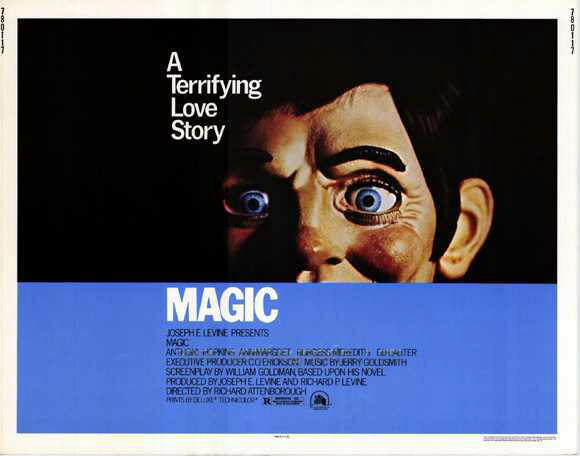
"Abracadabra, I sit on his knee. Presto, change-o, and now he's me! Hocus Pocus, we take her to bed. Magic is fun...we're dead." --The tagline to Magic
Schizophrenia is still a very controversial mental-illness, and many psychiatrists have argued over the years that it doesn't even exist. But what we do know is that the mind can fragment into quasi-independent parts that can behave like personalities, or aspects of personalities. At any rate, the neuropathology of schizophrenia is unknown and has only been studied for some 100 years! Right now, the science tends toward heredity being a primary-cause, but there is no total consensus.
Enter the movies: While psychological horror is nothing-new to cinema, this 1978 film by Sir Richard Attenborough (A Bridge Too Far, Gandhi) is very-very special, and offers some interesting speculations. Originally a best-selling novel by William Goldman (who also wrote the screenplay), this is also the 'big-break' of Anthony Hopkins. It was the moment the public really took-note of this 40-year-old actor. Other than The Bounty (1984) this has to be his best film-performance, where he even had to learn to articulate a ventriloquist's dummy and throw his voice.
Hopkins plays Corky, an amateur magician who is too shy to charm an audience where he bombs at his first performance in the film's opening prologue, subbing for his dying mentor, "Merlin." Corky had become enraged and scolded the bored crowd and had a kind of a mental breakdown. Cut to two-years-later, and Corky is selling-out the same nightclub with a residency and lines around the block. There's been a strange transformation in the entertainer, and he's gained some kind of an edge.
Something happened over those two years and Corky's addition of a foul-mouthed ventriloquist's dummy named "Fats" has made his act wildly popular: he's funny and profane, spouting dirty-jokes and insults at his audience. Fats acts and looks like a distorted version of Corky, maybe even his shadow self, a nice touch of the Jungian in the screenplay. But, was it "Fats" who chewed-out the audience two years ago, or was it Corky? Or was it some supernatural force, a dead soul raging against the living? As in life, there are no easy answers in the late Sir Richard Attenborough's version of Magic. Screenwriter Goldman and director Attenborough let us decide for ourselves, and it's this enigmatic style that makes Magic so interesting and incredibly chilling. Jerry Goldsmith's eerie score doesn't hurt either, it's reminiscent of Bernard Hermann. This is a small story with epic dimensions, the landscape of the human mind, the human soul. Magic is classic tragedy.
Sure, we know that Fats isn't really alive and that he's just an extension of Corky's tortured psyche, but there are a few moments where he literally moves without help, shot objectively! It is as if the disease has externalized itself, taking over the protagonist and even the narrative. The effect is especially eerie. There is a light-touch of ambivalence as to whether Fats is more than just a part of Corky's psychosis, but this is soon upended by several objective-views of his behaviors without Fats; but Attenborough keeps things ambivalent nonetheless, and all the way to the finale. Fats only moves a few-times without Corky, and sometimes Corky sounds like Fats when he gets angry. One almost gets a disembodied-sense watching this, a little taste of madness. And so, with his fame comes a fear of exposure of his illness. His show-business agent wants him to take a physical for a network television-appearance, and Corky refuses, escaping to his hometown in the Catskills.
He seems to know instinctively that he is mentally-ill and Fats the dummy even reminds him that, "We're special." Indeed "they" are, they are abnormal since it should be impossible for there to be more than one of them. A schizophrenic fear of persecution becomes obvious in the protagonist over time. Fats wants to return to Manhattan to fame-and-fortune but Corky doesn't, he wants to hide. The pressure builds as the two personalities fight, and Fats becomes jealous of a childhood love named Peggy, played by the legendary Ann Margaret. She runs the cabin Corky and Fats are hiding-out in, hiding from the world. Corky's relationship with Peggy can only be doomed from the start, and one gets the impression that because of his illness he's never truly grown-up and that he's incapable of an adult relationship with anyone.
There is something so creepy about Fats, and it isn't hard to believe that he comes from somewhere deep and unknown within the human mind, a kind of atavistic force that might have been useful once for the purposes of survival; at one time, we may have had to be many people. Therefore, Fats is a force rather than a personality, and he is virtually rage and vengeance personified. Corky repeats his fears of failure to Peggy in a mind-reading session with playing-cards, and it is here that it seems Corky isn't playing with a full-deck (sorry, I had to write it). Is it a case of MPD (Multiple-personality disorder)? Is Fats a primeval darkness within Corky, brought-on by his illness and magnified? It seems to be a complex combination of many things, and the descent-into-madness of such a likable character is very unsettling and saddening in a way that only insanity is capable of being. Though it's best to remember that this is a movie version of mental-illness, it works, and has a very powerful artistic truth to it, therefore an objective truth. Corky is basically a paranoid-schizophrenic with some writing-touches.
He seems to know instinctively that he is mentally-ill and Fats the dummy even reminds him that, "We're special." Indeed "they" are, they are abnormal since it should be impossible for there to be more than one of them. A schizophrenic fear of persecution becomes obvious in the protagonist over time. Fats wants to return to Manhattan to fame-and-fortune but Corky doesn't, he wants to hide. The pressure builds as the two personalities fight, and Fats becomes jealous of a childhood love named Peggy, played by the legendary Ann Margaret. She runs the cabin Corky and Fats are hiding-out in, hiding from the world. Corky's relationship with Peggy can only be doomed from the start, and one gets the impression that because of his illness he's never truly grown-up and that he's incapable of an adult relationship with anyone.
There is something so creepy about Fats, and it isn't hard to believe that he comes from somewhere deep and unknown within the human mind, a kind of atavistic force that might have been useful once for the purposes of survival; at one time, we may have had to be many people. Therefore, Fats is a force rather than a personality, and he is virtually rage and vengeance personified. Corky repeats his fears of failure to Peggy in a mind-reading session with playing-cards, and it is here that it seems Corky isn't playing with a full-deck (sorry, I had to write it). Is it a case of MPD (Multiple-personality disorder)? Is Fats a primeval darkness within Corky, brought-on by his illness and magnified? It seems to be a complex combination of many things, and the descent-into-madness of such a likable character is very unsettling and saddening in a way that only insanity is capable of being. Though it's best to remember that this is a movie version of mental-illness, it works, and has a very powerful artistic truth to it, therefore an objective truth. Corky is basically a paranoid-schizophrenic with some writing-touches.
Perhaps Magic's best scene is when Corky's agent (played with subdued class by the late, great Burgess Meridith) finds him at his hideaway and challenges him about his sanity: "Corky, can you make Fats shut up for five minutes?" Corky can't do it, and the scene is hilarious, heart-breaking, and horrific. Eventually, Corky kills a couple people in a feeble attempt to hide his illness and it all just snowballs. Exposure is inevitable, and I leave the ending for you to watch yourselves. Magic is a film that is both funny and sadly poetic, portraying the dying of a beautiful, prismatic-mind that had so much to give but couldn't. This makes Corky the classic misunderstood "monster," and Magic, a horror film. He simply cannot help himself.
Mental-illness in the universe of Magic is tragedy--as it should generally be viewed as--and our connection with Corky is almost like that of an accomplice, just as with Norman Bates in "Psycho" (1960) when we guiltily worry he's going to be discovered. We want him to keep hidden as a part of natural empathy. Magic is that wild ride that is both humanizing and sad, but also very entertaining, even a criticism of the entertainment world itself, not a very healthy place to be in most ways. After all, once Corky is sick, the crowd loves him. The more he openly reviles and despises him, the more they love him and his little friend. Fats, then, really is an externalization of his illness, and it all seems like a diseased version of the American Dream, a disease of another kind.
While the majority of schizophrenics aren't violent as in this classic movie portrayal of insanity, this could certainly happen, and that's why I find it so horrifying. People lose their minds, and they lose control to impulses that we and they do not understand entirely. This is the terrible horror behind Magic, it's black heart. Hopkins did the eerie voice of Fats, even throwing-his-voice, and he gave the dummy an old vaudeville/freak show barker quality. To these ears, he sounds like a street hood from 1920s New York City, like a completely other personality than Corky's. Fats sounds like someone who lived once in another body, rather than some strange voice from the depths of a tortured man's soul.
The twist-ending seems to support this possibility. So, one would imagine from Anthony Hopkins' performance that he was at least nominated for a major award. But, this was an independent film by Attenborough and producer Joseph E. Levine, so an Academy Award™ was out. It's ironic that so many films that win Academy Awards™ any-given-year are often forgotten, but ones like Magic are remembered fondly. As anyone knows, Magic is timeless.
The twist-ending seems to support this possibility. So, one would imagine from Anthony Hopkins' performance that he was at least nominated for a major award. But, this was an independent film by Attenborough and producer Joseph E. Levine, so an Academy Award™ was out. It's ironic that so many films that win Academy Awards™ any-given-year are often forgotten, but ones like Magic are remembered fondly. As anyone knows, Magic is timeless.
Tuesday, August 15, 2006
The Moon landing & Tin-foil Hats
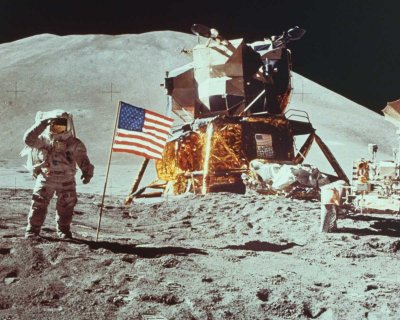
If you want to gauge how truly insane and moronic some Americans can be, just do a google search on "Moon landing conspiracy."
So contentious is the issue that the topic on Wikipedia is now blocked from editing. What idiocy! We have a President spying on most of us, three wars, and THIS is what 6% of us find most important?! Yes, according to a Gallup Poll in 1999, 89% of us believe that we landed on the moon in 1969-onwards, while 6% do not.
Amazing, and we know how they vote. I'm not giving any of the living-proponents of this crap theory any advertising, so here's the deadite who started it all: Bill Kaysing. Kaysing was generally a transient who worked a short time as a technical writer for Rocketdyne (like "Yo-Yo Dyne" from Buckaroo Banzai) until 1963, but was generally a bum who found a new way to make money. He could be called a former "disgruntled employee."
Fox News' overly-credulous 2001 special on this goofy conspiracy theory just goes without saying about the quality of their programming and of their viewers.
Some theories have Stanley Kubrick being part of the conspiracy, helping with the same effects he used in "2001: A Space Odyssey." But, it seems movies have probably played-a-hand in most of this.
In a brief scene in the James Bond thriller, "Diamonds are Forever" (1971, three years before Kaysing's book) there is the faking of a moonlanding! In 1978, the movie "Capricorn One" increased the popularity of this theory.
I saw Capricorn One when it was first released, and it is more relevant as an expression of post-Watergate cynicism towards the federal government than anything. Oh yeah, O.J.'s in it, nuff-said, it sucks.
Today, the tin-foil hat crew are rejoicing: NASA says it cannot-find the original master tapes of the video-feed from the first moonlanding. Big deal, we have copies from it, and I'm betting they locate them soon. It all reminds one of how much "aliens" from abduction accounts resemble aliens from bad 1950s B-movies. I'd chock-it-up to the fact that many people don't understand allegory and metaphor--they can only view the world, movies, books, words, as literal reality (like the Christian Bible). This makes them crazy, of course, and dangerously stupid. We now know the political results of this lack-of-consciousness. We saw it 60+ years-ago in Germany...
Monday, August 14, 2006
Gesualdo: Death for Five Voices (1995) review

This is the place where the modern horror genre begins--with characters like the Italian Renaissance Prince, Carlo Gesualdo. Possibly born in 1561 (or 1566, depending on who you believe), Gesualdo was born into nobility, and was the recipient of a Principality in the town of Venosa, and a Duke of the Kingdom of Naples. The Gesualdos were connected by blood-ties to nearly every noble family in Renaissance Italy.
Carlo was considered a child prodigy like Mozart, and was an accomplished performer of the lute and harpsichord.
In 1586, he married his cousin, Maria d'Avalos. The woman was known for both her incredible beauty and her amorousness (though this is debatable), and the marriage was possibly ill-fated due to Gesualdo's abusive behavior. It is unknown whether this is the reason for d'Avalos's infidelities, though his second wife consulted a witch who poisoned the Prince in an attempt to enchant him. Both this wife and a concubine were imprisoned and tortured for the deed, with the concubine dying shortly-afterward from the ordeal. D'Avalos would meet a much darker fate.
It's uncontroversial that the Prince was a sadist, and Gesualdo had wanted them both hanged, but the Church interceded. There is a strong possibility that the Prince plotted to murder his wife for years. However, it does appear that infidelity was the reason why Carlo slaughtered d'Avalos and her lover in what is considered the most heinous murder in the history of Italy and easily of music.
By 1590, the marriage had gone sour: the Prince had found the apartment that the two lovers were using from an uncle (a Cardinal who had unsuccessfully attempted his own affair with d'Avalos). The place was a niche-room in his own palace, and he commenced the planning of a murder. In a premeditated act, Gesualdo told d'Avalos he would be away on a hunting trip overnight with a party of his own senechals--except that he and this personal guard waited nearby until the two had consummated their lovemaking, finally falling asleep.
Gesualdo kicked-in the door and stabbed Maria d'Avalos dozens-of-times in the abdomen and vagina, as well as similar sexual-mutilations on her consort, the Duke of Andria. It is told in local legends of Venosa that after Gesualdo had dragged their bodies into the street, a San Dominican monk committed an act of necrophilia on the body of d'Avalos, adding to the depravity of the event.
This didn't sate the Prince's bloodlust: Gesualdo had their bodies displayed publicly on the steps of a Church, eventually using the corpses for an alchemical experiment that rubberized their organs and circulatory-systems. The bodies are still on-display in a Church in Venosa, making Carlo Gesualdo an evil genius who was clearly ahead of his time in almost every respect. Because of Gesualdo's station as a Prince there were no charges.
From the time that Carlo Gesualdo murdered his first wife, until his death in 1613, he did penance by composition and flagellation.
It is said that he suffered from asthma and constipation, and was possibly further enfeebled by his poisoning by the witch and sorcerer at-the-behest of his concubine and his second wife. For the rest of his life, Gesualdo composed his haunting choral madrigals, and was well-known in his time as a composer of inspired genius. Today, he is even more well-known, which is probably due to the depraved life he led and this documentary by the also-legendary Werner Herzog (commissioned in 1995 by ZDF).
The murders haunted Gesualdo until the end of his life. Immediately after the killings, he personally cut-down the forest surrounding Castle Gesualdo, much like Macbeth's fear of Birnham woods. Interest in the occult was universal in the time of the Prince, and it begs-the-question whether Shakespeare and Christopher Marlowe were informed of Gesualdo's story through the court of Elizabeth I. An unsurprising number of Elizabethan and Jacobean plays come from stories with origins in Renaissance Italy. It's my opinion that this fact bears some investigation in the case of Carlo Gesualdo. By the end of his life, Prince Carlo Gesualdo was madder than Macbeth. There is every reason to think that the modern horror story was influenced by the horrific acts of Gesualdo. A hunch, yes, but it deserves investigation.
Werner Herzog does an incredible justice to the story of Gesualdo, and the events which made him famous. But he goes further by interviewing contemporary residents of Venosa on the impact left by the man into today, and his results are interesting and often seductively enigmatic. The region of Italy that he once reigned over is still haunted by him and other aristocrats.
Today, many people around the town still shun the name of Carlo Gesualdo, while the mentally-ill of the region fancy that they ARE the Prince, reincarnated. Others, such as the mad opera singer who "haunts" Castle Gesualdo, fancy they are Maria d'Avalos. It seems that the belief in magic is alive-and-well in Venosa and Ferrara, where local occultists enter the castle to exorcise it regularly with all manner of methods (one uses a bellows bagpipe).
With an extraordinary skill, Herzog wipes-away centuries with his approach, making this story a living one about the battles within all of humankind that continue to this day. The music of Carlo Gesualdo is unearthly, yet it is so terminally human, just like his legacy. Perhaps we find him so interesting because he was nearly 300-years ahead of his time, compositionally and alchemically. "Five Voices" is the documentary as high art and possibly Herzog's best work in the medium. There is a fascinating magic to this story, and the director has captured some of it on film.
Revised, 03.28.2009
Subscribe to:
Posts (Atom)