Showing posts with label Berkeley. Show all posts

Tuesday, September 05, 2006

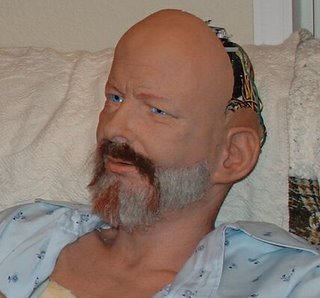
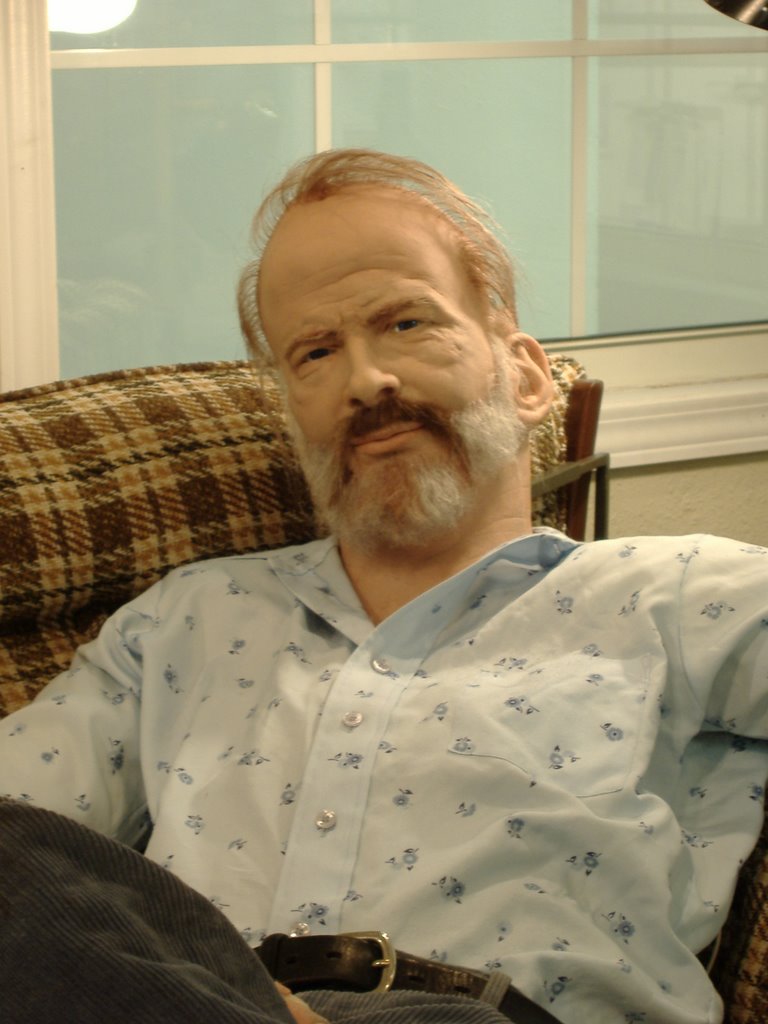
Philip K. Dick Simulacrum Still Missing (with a head full of speed)


The story of the missing Philip K. Dick simulacrum is a bizarre tale that began February, then had an end of June update again this year (still missing). As though taken from one of Dick's stories, the android was displayed prominently at a Chicago sci-fi convention (they did a Q&A), and Comic Con in San Diego.
But, after leaving with the body and head for Texas, main designer David Hanson forgot to retrieve it from the overhead carry-on compartment. Allegedly, the airline located it again, and sent it back to Hanson, but it has yet to arrive.

Yeah right, some baggage handler is using it for a Halloween decoration this year!

Imagine if they got it to talk: you would have a new PKD novel unfolding into our reality.
What if a janitor from Puerto Rico found him? It would be hilarious if the person who found it learned from the simulacrum, and returned the head out of guilt!

I'd like to think the simulacrum awoke, and realized he really was Philip K. Dick, and decided to live a normal life somewhere. He would have his coffee in the morning, smoke, and have his beer in the evenings. He could do speed. Maybe he could find a cheap-apartment outside of Berkeley--the real Philip K. Dick wouldn't even recognize the town anymore.

He could go to Disneyland, becoming more-and-more like the original man. Who knows, maybe he could write like Dick eventually. But somehow, I think the android would become sad at how much the world had changed since Phil's death in 1982, but also how little it has changed. It's a bittersweet dream that might convince me there is some divine architecture to the universe, but as in Dick's novels, truth and proof of the divine will always be something elusive to humanity.

The irony of all this is that the CPU of the android has around 10,000 pages that have remained mostly unpublished from Dick's private writings. They could even be from his legendary "Exegesis", which is still basically unpublished in its 2 million word form. So, I would imagine the children of Philip K. Dick are a little worried about the whereabouts of the head. This is a strange thing when a lot of other databases have gone-missing, all in the same period...


Hanson has vowed that if the head isn't found, he'll build another one. That would be great, and I'd pay a lot of money just to sit and talk to a piece of Philip K. Dick--the only one we have left now. The creation of this android is exciting, and it also evokes the sadness embodied by Philip K. Dick and his canon. It is so miraculously infused with the spirit of the man, and it offers some hope.
I could see androids saving humanity from-itself, and wouldn't it be beautiful if Dick was partly-responsible for it? The loss to science-fiction was enormous when he died, though hardly anyone knew it at the time.


PS: Next models by Hanson Robotics Inc. wish-list: Edgar Allan Poe, H.P. Lovecraft, Orson Welles, Josef Goebbels, Mark Twain, Herman Melville, William Blake, Winston Churchill, Ted Bundy, Aleister Crowley, V.I. Lenin, Josef Stalin, St. Francis, Che Guevara, Sam Peckinpah, Sergio Leone, John Dillinger, Al Capone, Graham Parsons, John Wilkes Booth, Nat Turner, Wolfgang Amadeus Mozart, Augustus Caesar, Bugs Malone, Jimi Hendrix, Moctezuma II, Napoleon, Pablo Picasso, Yukio Mishima, Thomas Edison, Jim Morrison, Woody Guthrie, Lenny Bruce, John Brown, Pontius Pilate, Hernan Cortez, Grigori Rasputin, Sitting Bull, John Lennon, Leonardo DaVinci, Mary Shelley, John Ford, Christopher Columbus, Aldous Huxley, Heraclitus, Ted Bundy, Siddartha, Sid Vicious, St. Paul, Malcolm X, Thomas Paine, Carlo Gesualdo, H.H. Holmes, Aristotle, Socrates, Plato, Simon Magus, Sir Isaac Newton, Calamity Jane, Friedrich Nietzsche, Zoroaster, Pancho Villa, Ambrose Bierce, Edward R. Murrow, George Orwell, Charles Dickens, Lord Byron, Comte St. Germaine, Adam Weishaupt, Joan of Arc, Heinrich Himmler, Adolf Hitler, Emma Goldman...

Perhaps the simulacrum became paranoid (head full of speed), and decided it was time for a trip to the New Synanon under the pseudonym Horselover Fat. But what did it mean, and why had his car broken-down?

Sunday, August 13, 2006

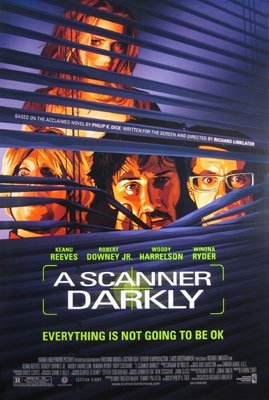
A Scanner Darkly review


1Corinthians 13:11 When I was a child, I spake as a child, I understood as a child, I thought as a child: but when I became a man, I put away childish things.

1Cr 13:12 For now we see through a glass [the original-Greek connotes "mirror," not a window], darkly; but then face to face: now I know in part; but then shall I know even as also I am known.

1Cr 13:13 And now abideth faith, hope, charity, these three; but the greatest of these (is) charity.


S
ubstance-D is a powerful hallucinogen, a drug that when used over a prolonged period causes a bicameral-split in the user's personality. They become psychotics with multiple-personalities. Users call the drug "death," an appropriate moniker that reflects the eventual disintegration of the user's personality--or, at least in Philip K. Dick's science-fiction novel , "A Scanner Darkly" (1977).

Dick's adult life was spent primarily in-and-around Berkeley during the heyday of the antiwar movement and the American counterculture (though it really has continued into now). Many of the characters in his story like Ernie Luckman, Charles Freck, Donna Hawthorne, James Barris, and even Bob Arctor, were based-on real people that Dick had allowed to hang-out at his home while he wrote. Most of them were junkies and losers (and a few robbed him), but Dick felt a real pity and empathy for them. I share this with him, as despicable as addicts can be.

If you have ever truly been a part of the counterculture, this is going to be familiar-territory, and it will be both a funny reminder and a tragic one. I can say with authority that the film and the novel are pretty authentic in depicting the paranoia and the toll that the "lifestyle" takes on people. But, in classic Burroughsian-fashion (Philip K. Dick was an avid reader of William S. Burroughs, like many countercultural writers of that time), he shows that there are facets of the lifestyle that are worse, far-worse than "straight" society. Addicts are victims in more ways than you might suspect.

Think of addiction as a pyramid--as Burroughs enjoined us to do--and you'll understand that the so-called "drug problem" is about social control of rebellious populations and an excuse towards about gradually foisting a totalitarian system onto a democratic one. Dick homes in on this theme with incredible perceptiveness, simplifying it for the average reader. Yet the majority of Philip K. Dick novels are about the elusiveness of the underlying reality that constantly escapes us, the search for meaning within this reality, and the need for empathy in our lives. Like numerous other social observers, Dick saw us all becoming dehumanized by modern consumer culture, even becoming commodities through "reification." Richard Linklater has done this particular theme and story more justice than any other director has or possibly will anytime soon.

Linklater is a product of the American counterculture, which should be obvious glimpsing "Slackers," "Dazed and Confused," "Waking Life," and virtually all of his most personal films. He has also done what few writer/directors have ever attempted which is a story that is basically anti-drug (hard-drugs, not pot) without being preachy and boring.

I have read "A Scanner Darkly," at least six times and I can say that Richard Linklater has nailed the story, its meaning, and the hard lessons learned by Philip K. Dick and people like myself in the counterculture. Unlike many anti-drug films, we are told by the character Bob Arctor why he began his addiction: he hated his conformist daily-grind life with the kids, the wife, and its consumer nightmare of meaninglessness. This is why most people become addicted-to-drugs. They can no longer stand life in the developed world and how controlled and repressed it is. They yearn for empathy, closeness, and community.

When life's options have become constricted by ever-greater concentrations of power (a situation fostered by politicians and lobbyists, and the inaction of most people), you get a society like ours, and the one in A Scanner Darkly. The lives of ordinary people become warped by the distortions in power-relationships, and it poisons society and people's minds and spirits. Before long, nobody trusts one another, it all becomes apparently "normal," and society begins to feed on itself.

After that, collapse comes, inevitably. The body politic crashes and a bloodbath emerges as the system crashes. It wasn't hard to see where things were going in the 1970s, especially after Watergate and earlier--and more important--revelations like the 1971 break-in of an FBI field office in Media, Pennsylvania that revealed the extent of spying on American citizens at that time. Now, it's become "normal," but at that time the public was alarmed and outraged. Now, the war on terror justifies everything, and up is down.

The NSA's current spying is nothing new. Philip K. Dick's own home was burglarized during the early-1970s and his tax-records were stolen. The likely motive was that he had been a war tax resister during the Vietnam War, which raged into the middle-1970s. It should be noted here that Dick Cheney was a Nixon and Ford administration staffer. We shouldn't wonder why we're back to square one. Because things have only gotten worse, Linklater's version of the Philip K. Dick story is nothing less than a call-to-action and a very radical film in a very good sense. If we continue not to act against these encroachments on our rights, we will end-up with a society that closely resembles the one in A Scanner Darkly. Since 1977, things have gone in this direction. But then, there's the (second) war on drugs again...

There is ample-proof that our government has had involvement in the drug trade with corporate complicity in some areas (think NAFTA). Like any great science-fiction tale, this is a cautionary one, and we ignore the message at our own peril. What Richard Linklater has crafted is a great film based on a great American novel, and it was fun watching Alex Jones be dragged-away by the police (again). If only that part of the movie had been real, but Jones has a tendency to screw-up, so we'll see if he gets popped again. Timeless.

Significantly Revised, 09.13.2008